Project Story: Upgrading Steel Formwork Tube Processing in Indonesia
In the construction industry, steel formwork plays a crucial role in shaping concrete structures. From bridges and high-rise buildings to infrastructure projects, steel formwork components must be manufactured with precise dimensions and durable structural strength.
In Indonesia, where construction activity continues to expand rapidly, manufacturers of steel formwork systems face increasing pressure to deliver consistent quality while controlling production costs. This case study tells the story of a steel formwork manufacturer that upgraded its production process by adopting a laser tube cutting machine for steel formwork manufacturing.
Instead of relying on traditional punching equipment, the company moved toward a more flexible laser-based processing solution designed to handle multiple steel profile types and improve long-term manufacturing efficiency.
Background: Steel Profiles Used in Formwork Systems
The customer operates in the steel formwork manufacturing industry, producing structural components used in construction molds and support systems.
Typical materials processed in the workshop include various steel profiles such as:
Square steel tubes
Rectangular steel tubes
Angle steel
Channel steel
These components are commonly used to build modular formwork frames that must withstand heavy loads during concrete pouring. Because these structures are repeatedly assembled and disassembled on construction sites, accuracy and durability of each steel component are critical.
For this manufacturer, square tubes in multiple dimensions formed the majority of daily production tasks.
The Challenge of Hard Materials and Tool Wear
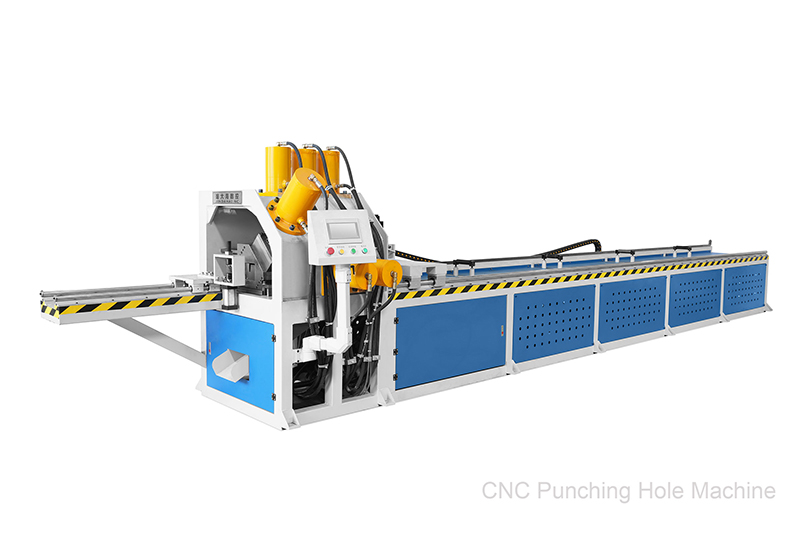
Before upgrading their equipment, the company used a CNC punching machine to perform hole processing and cut-off operations. While this method worked for softer materials, the hardness of the steel tubes used for formwork structures created significant operational challenges.
The punching tools experienced rapid wear, which resulted in frequent tool replacement and rising maintenance costs. Each replacement required machine downtime, interrupting production schedules.
Another limitation was the complexity of processing different material types. With punching equipment, changing dies and adjusting setups took additional time whenever the product specification changed.
As the variety of steel profiles increased, this workflow became increasingly inefficient.
Evaluating Alternatives to Traditional Punching
Faced with rising tool costs and production inefficiencies, the manufacturer began exploring alternative processing technologies.
Laser tube cutting technology quickly emerged as a strong candidate. Compared with mechanical punching, laser cutting does not rely on physical tooling to create holes or cut shapes. Instead, the cutting process is performed by a high-energy laser beam controlled by CNC programming.
This makes laser tube cutting for square and rectangular tubes particularly suitable for manufacturers handling multiple material types and changing product designs.
However, adopting laser technology required a solution that could also address the company’s material handling challenges.
Defining the Equipment Requirements
During project discussions, the customer outlined several important requirements:
The machine must handle multiple types of steel profiles, including square tubes, angle steel, and channel steel.
A semi-automatic chain loading system was preferred, allowing operators to arrange materials in batches for continuous processing.
The equipment needed to support a wide range of tube sizes used in formwork manufacturing.
The cutting system had to maintain stable performance when processing medium-thickness steel materials.
Production efficiency should improve enough that a single operator could supervise multiple machines.
These requirements formed the basis of the proposed solution.
The Proposed Solution: Semi-Automatic Laser Tube Cutting System
After analyzing the customer’s production workflow, we recommended a semi-automatic laser tube cutting machine designed for flexible steel profile processing.
The configuration focused on reliability and adaptability rather than extreme technical specifications. Key elements included:
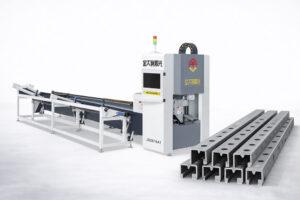
A semi-automatic loading rack capable of arranging multiple steel profiles
A precision clamping system suitable for various tube sizes
A fiber laser cutting unit optimized for medium-thickness structural steel
A CNC control system allowing hole cutting and profile cutting in one operation
This setup enables the entire processing sequence—from loading to finished parts—to be completed in a single continuous workflow.
Semi-Automatic Material Handling
Material handling is often one of the biggest challenges in steel fabrication, especially when dealing with heavy or long steel profiles.
With the semi-automatic loading system, operators can place several steel tubes onto the loading rack at once. The system then feeds materials automatically into the cutting area.
This method significantly reduces manual handling and allows continuous processing of multiple tubes.
For manufacturers processing diverse steel profiles, this workflow improves productivity without requiring a fully automated production line.
Integrated Hole Cutting and Cut-Off
Another key advantage of the system is its ability to combine hole processing and profile cutting in one operation.
Using CNC programming, the machine can perform multiple cutting tasks on the same tube, including:
Slot cutting
Notch cutting
Profile trimming
Length cutting
This integrated process eliminates the need for separate punching and cutting steps, simplifying the entire production workflow.
Designed for Hard Steel Materials
One of the reasons the customer chose laser technology was the difficulty of processing hard materials with traditional punching equipment.
Because laser cutting does not rely on mechanical tooling, the cutting quality remains stable even when processing high-strength steel tubes.
For steel formwork manufacturers, this means fewer consumable tool parts and more predictable production costs over time.
Production Workflow After Implementation
After installing the new system, the production workflow became significantly more streamlined.
Steel profiles are first arranged on the semi-automatic loading rack. Once positioned, materials are fed automatically into the cutting zone.
The machine then performs hole cutting and length cutting according to pre-programmed instructions. Finished parts are discharged automatically and prepared for the next stage of fabrication.
Supporting Efficient Steel Formwork Manufacturing
By integrating cutting and hole processing into one CNC-controlled system, the solution helps simplify steel component production for formwork structures.
Instead of relying on multiple machines and manual repositioning, the manufacturer now processes steel tubes using a single workflow designed for flexibility and efficiency.
This approach is particularly valuable for companies producing a wide range of steel formwork components.
Conclusion
This project demonstrates how a steel formwork manufacturer in Indonesia transitioned from tool-intensive punching equipment to a more flexible laser-based production method.
By adopting a semi-automatic laser tube cutting solution, the company was able to reduce tooling costs, simplify processing steps, and improve overall production efficiency.
For manufacturers working with hard steel profiles and diverse product types, laser tube cutting offers a practical alternative to traditional punching methods while maintaining the flexibility required for modern fabrication workflows.