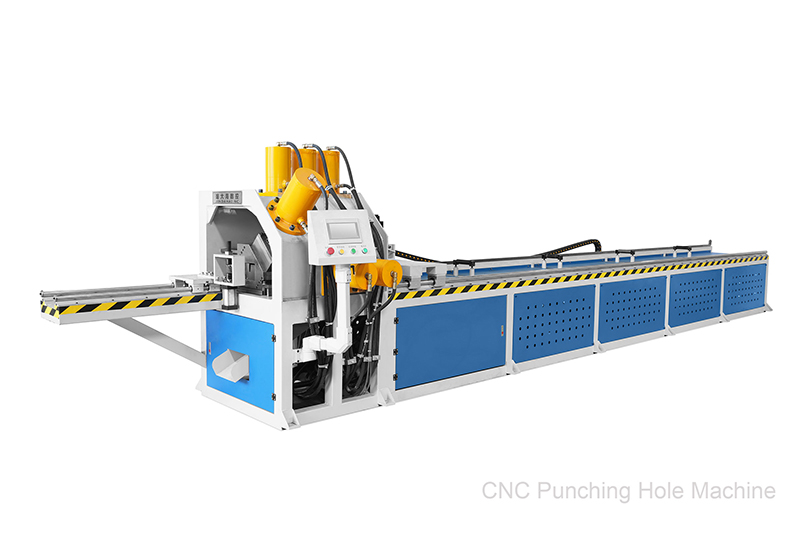
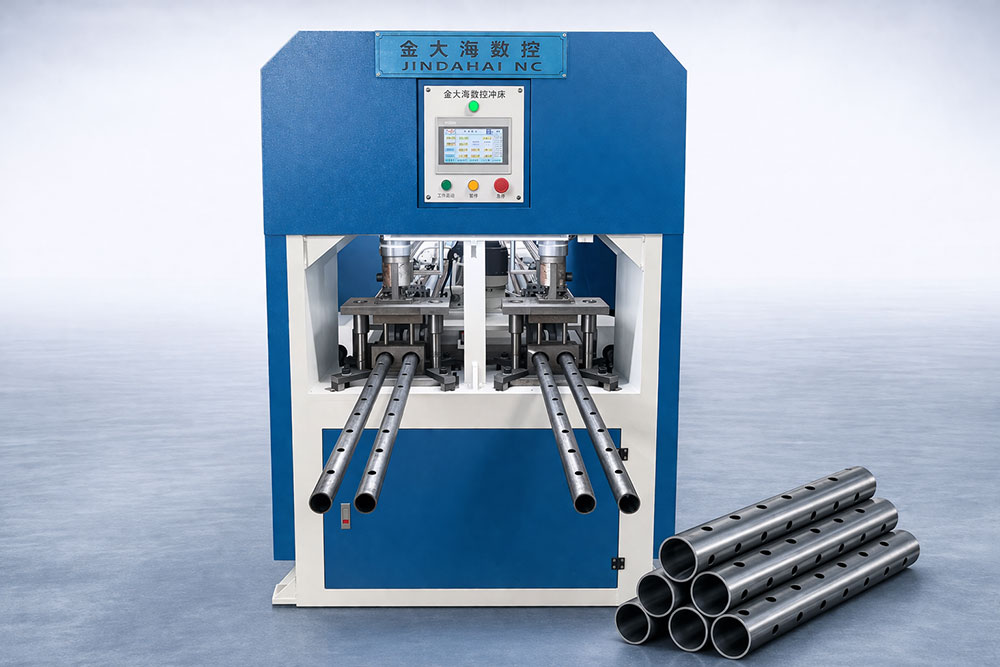
In today’s manufacturing environment, metal fabricators are expected to deliver parts faster, hold tighter tolerances, control labor costs, and respond more flexibly to customer requests. These pressures affect nearly every stage of production, from raw material handling to final assembly. Among all the machines used in profile and structural metal processing, one type of equipment has become especially important because it solves several production problems at the same time: the CNC punching machine.
At a basic level, punching seems simple. A machine creates a hole in metal, and the part moves on. But in real production, the punching stage affects much more than one hole. It affects whether a bracket lines up during assembly, whether a support member fits its connection point, whether a storage upright accepts bolts smoothly, and whether a downstream team needs to stop and correct dimensional mistakes. In other words, punching is not an isolated process. It influences workflow, quality, and delivery performance across the factory.
This is why more manufacturers are rethinking how they handle repeated hole processing. Manual marking and drilling may still be workable for very small jobs, but once order quantities rise, material varieties expand, and lead times shrink, older methods quickly show their limitations. Operators spend too much time measuring. Positioning differences appear between shifts. Rework increases. Material waste grows. Production managers have less confidence in output planning.
A CNC punching machine changes this situation by bringing programmed control into the process. Instead of depending heavily on repeated manual judgment, the machine follows defined instructions for hole position, spacing, quantity, and sequence. That allows factories to improve repeatability, maintain a steadier production rhythm, and reduce the amount of variation that comes from manual work.
For companies producing structural parts, shelving systems, solar supports, enclosures, framework components, and other profile-based products, CNC punching has become more than a helpful upgrade. It is now part of how modern production stays competitive. This article looks at CNC punching from a practical industrial perspective: what the machine is, where it is used, how it works, how to operate it correctly, and why it brings real value to day-to-day manufacturing.
## What a CNC Punching Machine Really Does
A CNC punching machine is an automated processing system designed to punch holes, slots, and other shaped openings into metal materials according to numerical instructions. “CNC” stands for Computer Numerical Control, which means the movement and punching actions are directed by programmed data rather than by repeated manual positioning alone.
That definition is technically correct, but it still does not fully explain why the machine matters. In real workshop use, the machine is valuable because it turns repeated hole processing into a controlled, repeatable system. The operator no longer needs to mark every location manually or rely on visual alignment for each cycle. Instead, once the correct program is entered and verified, the machine repeats the same work pattern across part after part.
This matters in industries where metal components must match later operations precisely. A hole that is slightly out of position may not seem serious when viewed alone. But if that part later moves into welding, bolting, fitting, or site installation, the small error can become a large problem. One inaccurate punching stage can create delays through the rest of the workflow.
That is why many manufacturers view a metal punching system not simply as a hole-making device, but as a quality-control tool. It protects consistency. It supports predictable output. It helps reduce the chain reaction that begins with inaccurate positioning. This is especially valuable in medium- and large-volume production, where even a small error rate can lead to significant losses over time.
Different CNC punching machines are designed for different material forms. Some focus on flat material, while others are intended for square tubes, round pipes, rectangular sections, angle steel, channel steel, or other profiles. Some punch only. Others combine punching with cutting, notching, or marking. The exact structure varies, but the central purpose remains the same: to improve speed and consistency in repeated metal processing.
## Why This Equipment Has Become More Important
The rise of CNC punching is not just a technology trend. It reflects a deeper change in what factories must achieve. Buyers want shorter lead times. Projects often involve more product variation. Quality expectations are higher. And many manufacturers need to increase output without increasing labor in the same proportion.
Under those conditions, traditional methods become harder to scale. A skilled operator may still produce acceptable work manually, but when the order size grows, problems appear. Manual measuring takes time. Repetition increases fatigue. Differences between workers become more visible. Production plans become harder to stabilize because results depend too heavily on individual execution.
CNC punching helps reduce that dependence. Once the program is proven, the machine follows the same logic each cycle. It does not forget the spacing. It does not estimate the position differently on the next part. It does not slow down because the job is repetitive. That consistency is one reason the machine matters so much in real industrial environments.
Another reason is labor structure. Many factories today face a shortage of experienced workers, especially for repetitive production roles. Even where labor is available, businesses increasingly want operators to supervise systems rather than spend time on repeated measuring and manual handling. A CNC punching machine fits that direction. It does not eliminate the need for skilled people, but it allows skilled people to focus on setup, verification, and quality control instead of repeating the same low-value steps all day.
There is also a strong business reason. When a factory can produce parts more consistently, it can quote with more confidence, schedule with more confidence, and reduce the hidden costs of rework. That is why the machine matters not only to production teams, but also to sales, planning, quality, and after-sales performance.
## Typical Products and Industries That Use CNC Punching
One of the strongest points of CNC punching is its wide relevance across manufacturing sectors. The machine is not limited to one narrow market. It is useful wherever metal parts require repeated and accurately positioned holes.
In structural fabrication, punched components are common in supports, brackets, connection parts, and framework members. Hole position accuracy directly affects how those parts fit during assembly. For that reason, CNC punching is highly relevant in steel structure support production, where repeated hole patterns must remain consistent across many parts.
In warehouse and storage manufacturing, repeated hole spacing is often central to product function. Shelf uprights, rack frames, and support beams must be punched in standard patterns so that assemblies remain compatible. Factories serving shelving and rack applications benefit from automation because it reduces manual workload while maintaining regular spacing and dependable output.
The same is true in the solar field. Mounting rails, support brackets, and related components frequently require large numbers of repeated holes for bolts and installation hardware. Because these parts are often produced in batches, CNC punching is a practical fit for solar support components.
Another large category is tube and profile fabrication. Many manufacturers process square tube, round pipe, rectangular tube, angle steel, and channel sections into components for furniture, fencing, industrial supports, equipment frames, and fabricated structures. In these situations, broad product-page links are sometimes less useful than direct application examples, so article references to tube and profile fabrication are often best connected to case-oriented pages.
Electrical enclosures, transport accessories, agricultural structures, and infrastructure-related fabricated parts can also involve repeated punching operations. The common factor across all these industries is not the final market itself. It is the production need: repeated, accurate, efficient hole processing in metal.
## What Materials and Shapes Can Be Processed
A CNC punching machine is not defined only by its control system. Its usefulness also depends on the materials and profiles it can process effectively. Most industrial models are designed to handle commonly used metals such as mild steel, stainless steel, aluminum, galvanized steel, and certain alloy materials. However, actual capability depends on machine structure, punch force, tooling design, and material dimensions.
In terms of shape, many CNC punching systems are used for flat bar, angle steel, channel steel, square tube, round pipe, and rectangular sections. Some are optimized for one profile type. Others are more flexible and can be configured for different cross-sections. This is why buyers should never assume all CNC punching machines are interchangeable. A machine that performs well on light profile work may not be ideal for heavier structural sections, while a machine built for heavy-duty work may be less efficient for lighter, smaller parts.
Material thickness also matters. Thicker walls require more punching force and a more robust machine frame. Hole shape matters as well. Round holes are common, but many applications also require slots, oblong holes, or customized forms. Those needs affect tooling, cycle planning, and machine selection.
The relationship between material and tooling is especially important. Good hole quality depends not only on machine power, but also on proper punch and die matching. If the tooling is poorly selected, the result may be burrs, inaccurate edges, accelerated wear, or unstable production. That is why serious manufacturers think about punching as a system made of machine, tooling, material, and process discipline, not just one piece of equipment.
## How CNC Punching Works on the Shop Floor
From a distance, the working cycle of a CNC punching machine may look straightforward. Material enters, the punch moves, and the part comes out. But inside that seemingly simple workflow is a coordinated system involving program logic, feeding accuracy, clamping stability, and tooling condition.
The process begins with job preparation. The operator reviews the drawing or production requirements, confirms the material type and dimensions, and enters the punching pattern into the control system. This may include hole position, spacing, quantity, sequence, and part length. Some machines use simplified direct input, while others support more advanced digital workflows.
Once the program is ready, the material is loaded. In smaller operations this may be done manually. In higher-output environments, feeding aids or automatic loading devices help improve efficiency and reduce labor intensity. Support structures are often important here, especially for long profiles or tubes that may sag or shift if not held properly.
The machine then positions the material according to the program. Servo-controlled feeding systems are commonly used because they help maintain repeatable movement along the workpiece. When the material reaches the correct position, the punch descends into the die and forms the hole. The system repeats this cycle until all programmed punching positions are completed.
What makes this workflow effective is repeatability. A manual process may produce a good result once, but industrial production requires a process that produces the same good result repeatedly. That is where CNC punching offers its greatest value. It converts one successful setup into a reliable production pattern.
In some production environments, the punching stage is combined with cutting or marking. In others, punching is followed by welding, forming, coating, or assembly. In either case, the quality and consistency of the punching stage directly affect what happens next. That is why factories that care about downstream efficiency often invest first in stabilizing upstream processes like punching.
## How to Use the Machine Correctly
A CNC punching machine is only as effective as the way it is prepared and operated. Automation improves efficiency, but it does not automatically fix poor process discipline. Good results depend on correct setup, correct tooling, correct clamping, and attentive supervision.
The first requirement is accurate job review. Operators need to confirm the drawing, material size, hole size, spacing, and orientation before the program is run. A small programming error can create a large batch of incorrect parts very quickly, so verification at the start of the job is essential.
The second requirement is tooling selection. The punch and die must match the required hole shape, material grade, and material thickness. Using unsuitable tooling may reduce hole quality, increase burr formation, and shorten tool life. Tool wear must also be checked regularly. Even a well-programmed machine can produce poor results if the tooling condition is neglected.
The third requirement is material stability. Long or irregular profiles need proper support so that feeding remains consistent. Weak clamping can allow movement during the cycle, which immediately affects hole position accuracy. In real production, many punching problems are not caused by the control system at all. They are caused by poor material handling.
A first-piece inspection should always be carried out before full production begins. The sample part should be checked for hole position, spacing, edge quality, and overall dimensional correctness. This simple habit prevents expensive batch mistakes and should be treated as standard practice, not optional extra caution.
During the run itself, operators should continue to observe the machine. Unusual vibration, noise, tool marks, or feed inconsistency can indicate a developing issue. CNC equipment reduces manual repetition, but it still benefits from skilled human attention.
Finally, maintenance plays a direct role in daily performance. Cleaning, lubrication, clamp inspection, and tooling care all contribute to more reliable output. Factories that treat maintenance seriously usually see the benefit not only in machine life, but also in consistent product quality.
## Benefits That Go Beyond Speed
Speed is often the first benefit people mention when they talk about CNC punching, but it is not the only one, and in many cases it is not even the most important one.
A major advantage is consistency. When hole positions are controlled by a program rather than repeated human estimation, the results become more stable from one part to the next. This reduces downstream fitting issues and makes the entire manufacturing chain easier to manage.
Another key benefit is lower labor intensity. Manual punching and repeated drilling require continuous measuring, aligning, and handling. CNC punching reduces those repetitive tasks and allows operators to focus more on setup and supervision. In labor-constrained environments, this can be a meaningful competitive advantage.
Material savings are another benefit. Inaccurate punching leads to scrap, rework, and hidden cost. With proper setup, CNC punching reduces positioning mistakes and improves first-pass yield. Over time, that contributes directly to profit.
Safety can also improve. By reducing repeated direct operator involvement in the punching zone, CNC systems help create a more controlled workflow. The exact safety gain depends on machine design and guarding, but automation generally supports better working conditions than highly repetitive manual processing.
Perhaps most importantly, CNC punching improves production predictability. A factory that can repeat jobs with the same program, the same setup logic, and the same output standard can plan capacity more confidently. That stability matters for delivery promises, scheduling, and customer satisfaction.
## How to Think About Machine Selection
Choosing a CNC punching machine should begin with the product, not the catalog. Buyers need to look first at what materials they process, what shapes they handle, what hole types they need, and how much output they require.
A factory producing angle steel supports does not have the same needs as one producing square tube components. A workshop focused on repeated batch orders may prioritize feeding speed and automation. Another focused on custom work may value flexible setup and simpler programming. Machine selection must follow actual production logic.
It is also important to consider website and marketing structure when planning content and internal links. If the website has one broad CNC punching product page and several industry-specific case pages, then article links should reflect that structure. Broad equipment terms should point to the core product page. Application-specific phrases should point to the relevant industry examples. This creates a more logical experience for both users and search engines.
Support and service are another major factor. Tooling availability, spare parts response, training quality, and long-term technical support often matter more in real production than a single headline machine specification. The best machine is not just the one that looks impressive. It is the one that continues to support stable production over time.
## Common Mistakes Manufacturers Should Avoid
One common mistake is viewing punching as a minor process that does not deserve close attention. In reality, punching accuracy can affect assembly, delivery speed, and customer satisfaction. A weak punching stage often creates hidden problems later.
Another mistake is skipping first-piece verification. Some factories trust the program too quickly and move directly into batch production. This is risky. Even a small input error can create many defective parts in a short time.
Poor maintenance is also a common issue. Tool wear, loose clamping, insufficient lubrication, and neglected inspection may not stop production immediately, but they often reduce quality gradually until the problem becomes expensive.
Finally, some manufacturers buy equipment that does not match their actual product mix. A machine should be chosen based on real materials, real order types, and real production goals, not just price or appearance.
## Final Thoughts
CNC punching matters because it improves more than one operation. It improves repeatability, supports production planning, reduces labor intensity, and helps factories protect quality across larger and more demanding workloads. In industries where metal profiles and punched components are common, it has become a practical foundation for stable manufacturing.
For companies still relying heavily on manual processing, upgrading to CNC punching can remove many small but costly inefficiencies. For companies already adopting automation, the right punching system can strengthen process control and support future growth.
In modern fabrication, efficiency is not only about moving faster. It is about producing the right part, in the right quantity, with the right consistency, at the right time. That is exactly why CNC punching machines continue to matter in real production.