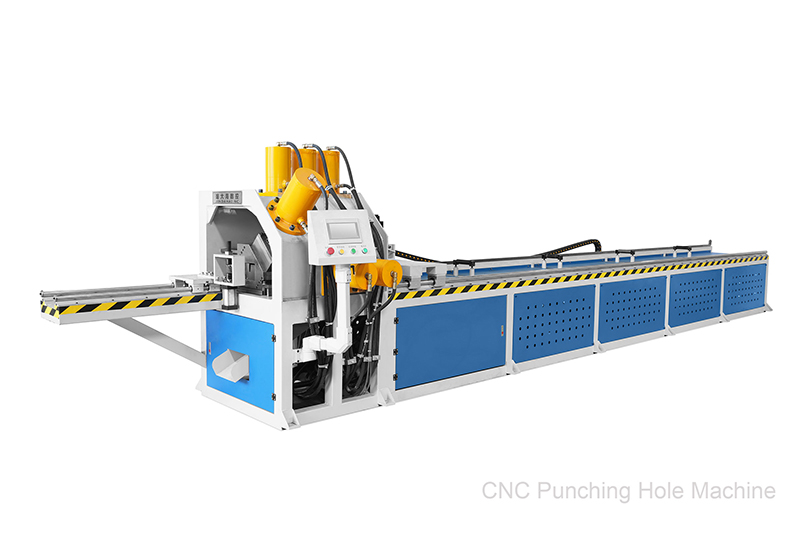
Project Story: Improving Angle Steel Processing for Power Tower Manufacturing
In the power transmission industry, production efficiency and processing accuracy directly affect delivery schedules, installation quality, and long-term project reliability. Manufacturers producing angle steel components for transmission towers often need to handle large quantities of materials with different hole types, different angle steel sizes, and strict identification requirements.
In Tajikistan, one power tower manufacturer was facing growing pressure from rising labor costs and increasing production demand. Their factory mainly produced angle steel components used for electrical transmission towers, power brackets, and related infrastructure projects.
As production volume increased, the limitations of traditional processing methods became more obvious. Multiple punching steps, repeated mold changes, manual marking, and separate cutting operations slowed down production and created unnecessary labor dependency.
To improve productivity and simplify the workflow, the customer decided to upgrade to a heavy-duty CNC angle steel punching line capable of completing punching, marking, and cutting in one integrated process.
Background: Large-Scale Angle Steel Processing for Transmission Towers
The customer mainly manufactures structural components for power transmission systems. Their products include various angle steel parts used in:
Power transmission towers
Electrical support structures
Substation frameworks
Heavy-duty electrical brackets
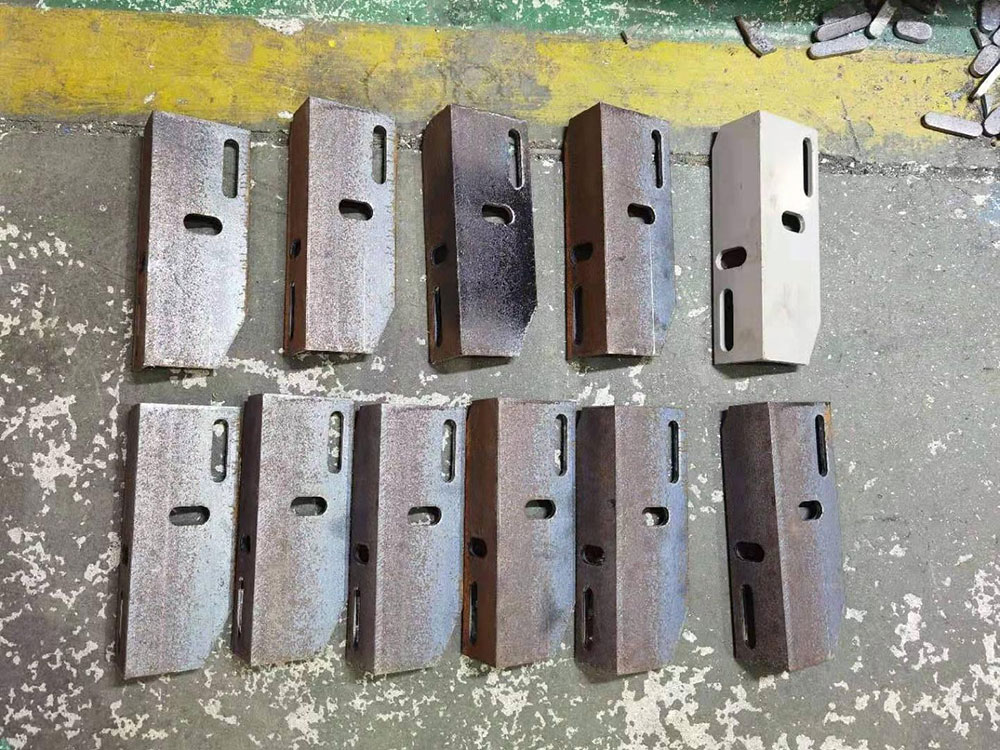
Because power tower projects require many different connection structures, the factory processes multiple angle steel sizes every day. Different projects also require different hole shapes, including round holes and elongated oval holes.
In addition, every finished component needs identification marking for installation and project management purposes.
The factory needed a production system capable of handling different angle steel sizes without repeated manual adjustments.
Production Challenges Before the Upgrade
Before introducing the CNC production line, the factory relied on conventional punching equipment and multiple processing steps.
Several production bottlenecks gradually affected efficiency.
Different angle steel sizes required frequent mold replacement.
Round holes and oval holes often required separate operations.
Marking and labeling had to be completed manually.
Material transfer between punching and cutting stations increased labor involvement.
Manual positioning reduced consistency during large production runs.
As project demand increased, maintaining production speed while ensuring stable quality became more difficult.
For power tower manufacturers, production delays can directly affect engineering schedules. The customer needed a more integrated and automated production solution.
Defining the Equipment Requirements
After reviewing the production process, the customer defined several key requirements for the new system.
One machine needed to process multiple angle steel sizes within a broad range.
The equipment needed to support double-side punching.
Different hole shapes had to be completed in one workflow, including round holes and elongated holes.
Each finished component required automatic marking for identification.
Cutting operations also needed to be integrated into the same production line.
The customer also wanted faster production speed without repeated mold changes.
Because the factory handles large production volume, operational safety and labor reduction were also important considerations.
The Proposed Solution: Heavy-Duty CNC Angle Steel Production Line
Based on the customer’s production requirements, we designed a customized CNC angle steel punching and cutting solution for power tower manufacturing.
The machine configuration focuses on production flexibility, stable operation, and continuous batch processing rather than excessive technical complexity.
Key features of the solution include:
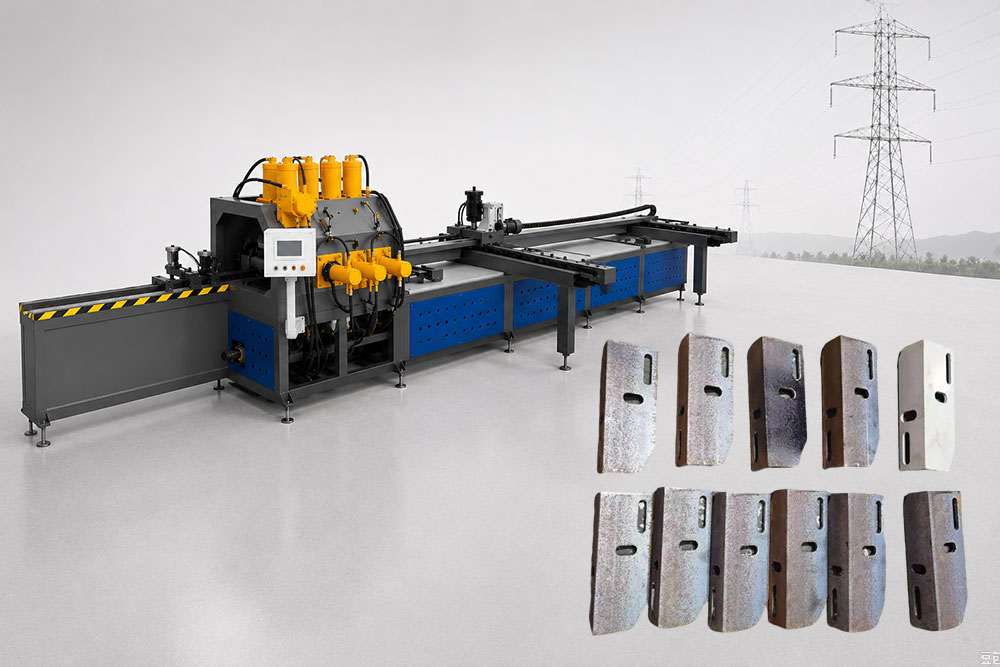
Multi-cylinder punching configuration for different hole types
Integrated marking system for product identification
Automatic feeding workflow for continuous processing
Double-side punching capability
Integrated cutting function for finished part separation
Flexible tooling support for multiple angle steel sizes
This allows the customer to process different products on one production line with fewer interruptions.
Integrated Workflow from Feeding to Finished Parts
In daily operation, angle steel materials are placed on the loading system in batches.
The production line automatically feeds the material into the processing area, where punching, marking, and cutting are completed according to the programmed layout.
Different hole types can be processed without repeated repositioning. Product marking is completed during the same workflow, reducing additional manual operations.
After processing, the finished components are discharged automatically and prepared for assembly or shipment.
This integrated workflow greatly improves processing continuity for high-volume production environments.
Why This Solution Fits Power Tower Manufacturing
Power transmission tower production requires a large number of structural components with repeatable hole positions and consistent dimensions.
Compared with traditional processing methods, CNC automation provides several advantages for this industry.
Multiple processing steps can be completed in one workflow.
Production speed becomes more stable during large batch manufacturing.
Different angle steel specifications can be handled more flexibly.
Manual positioning errors are reduced.
Product traceability improves through integrated marking functions.
For power infrastructure manufacturers, these advantages help maintain stable delivery schedules and reduce long-term operating costs.
Improving Production Efficiency and Labor Utilization
One of the biggest improvements for the customer came from workflow simplification.
Previously, workers needed to move materials between different machines for punching, marking, and cutting. With the integrated CNC production line, these operations are combined into one system.
This reduces material handling time and lowers dependence on manual labor.
At the same time, automatic feeding and CNC control improve operational safety because operators remain separated from the punching area during production.
For factories processing large quantities of angle steel every day, these improvements help create a more stable and efficient production environment.
Supporting Flexible Production for Different Projects
Power transmission projects often require different structural designs. A manufacturer may process several angle steel specifications within the same production schedule.
Because the CNC production line supports multiple tooling configurations and programmable layouts, the customer can adapt more easily to changing project requirements.
This flexibility is especially important for factories producing customized electrical tower components and infrastructure support systems.
The solution also reduces the need for frequent equipment replacement as production demand grows.
Long-Term Benefits for the Power Equipment Industry
For manufacturers in the power equipment sector, reducing downtime and improving production consistency are essential for remaining competitive.
By upgrading to an automated angle steel processing system, the customer established a more scalable production model.
The integrated punching, marking, and cutting workflow helps:
Reduce labor dependency
Improve production consistency
Increase processing speed
Reduce repeated setup operations
Improve material flow efficiency
Enhance workshop safety
These advantages support long-term production growth while helping manufacturers manage operating costs more effectively.
Conclusion
This project demonstrates how a power tower manufacturer in Tajikistan upgraded its production process with a heavy-duty CNC angle steel punching and cutting line.
The solution allows multiple angle steel sizes to be processed on one system while completing punching, marking, and cutting in a continuous workflow.
For manufacturers producing transmission tower components, electrical supports, and infrastructure brackets, CNC automation provides a practical way to improve efficiency, reduce labor costs, and maintain stable production quality in large-scale manufacturing environments.