Project Story: Improving Steel Processing for Electrical Cabinet Manufacturing
In the electrical equipment industry, production accuracy and efficiency directly affect assembly quality, welding consistency, and delivery schedules. Manufacturers producing electrical cabinet frames and support structures often process large quantities of channel steel and angle steel every day, requiring stable hole positioning, clean cutting surfaces, and repeatable dimensions.
In Germany, an electrical cabinet manufacturer faced increasing pressure to modernize its steel processing workflow. The factory mainly produced structural components for electrical cabinets and industrial electrical support systems using channel steel and angle steel materials.
As order volume increased, the traditional production process became a bottleneck. Workers needed to manually mark materials before gas cutting and hole processing, resulting in slow production speed, inconsistent hole quality, and heavy labor involvement.
To improve efficiency and reduce secondary finishing work, the customer decided to upgrade to a CNC punching and cutting solution for electrical cabinet manufacturing.
Background: Steel Components for Electrical Cabinet Structures
The customer mainly manufactures electrical cabinet frames, industrial control cabinet structures, and supporting steel components for electrical systems.
Their production materials include:
Channel steel used for cabinet bases and support frames
Angle steel used for structural reinforcement
Various connection parts for industrial electrical systems
Because these products require welding and assembly after processing, the quality of holes and cutting surfaces is very important. Irregular holes or rough cut edges increase welding difficulty and reduce assembly efficiency.
The factory needed a more stable and automated processing solution to improve overall production flow.
Challenges with Traditional Processing Methods
Before introducing the CNC processing line, the customer mainly relied on manual layout marking and gas cutting.
Several problems gradually affected production efficiency.
Workers first needed to measure and mark materials manually before processing.
Gas cutting created excessive slag and rough edges, requiring additional grinding work.
Hole sizes were not always consistent during repeated production.
Irregular cut surfaces reduced welding efficiency.
Multiple workers were needed across different processing stages.
As labor costs increased, the factory needed a more automated production approach.
For electrical cabinet manufacturers, production consistency is important because inaccurate steel parts directly affect cabinet assembly precision.
Defining the Production Requirements
After reviewing the production workflow, the customer defined several practical requirements for the new machine.
The equipment needed to process multiple channel steel sizes and angle steel specifications.
Automatic feeding and cutting were required to reduce manual handling.
Hole sizes needed to remain consistent during batch production.
Cutting surfaces needed to be cleaner and more suitable for welding.
The system needed to improve production efficiency while reducing labor dependence.
Because the factory produces different electrical cabinet structures, the machine also needed to support flexible processing requirements.
The Proposed Solution: CNC Punching and Cutting System
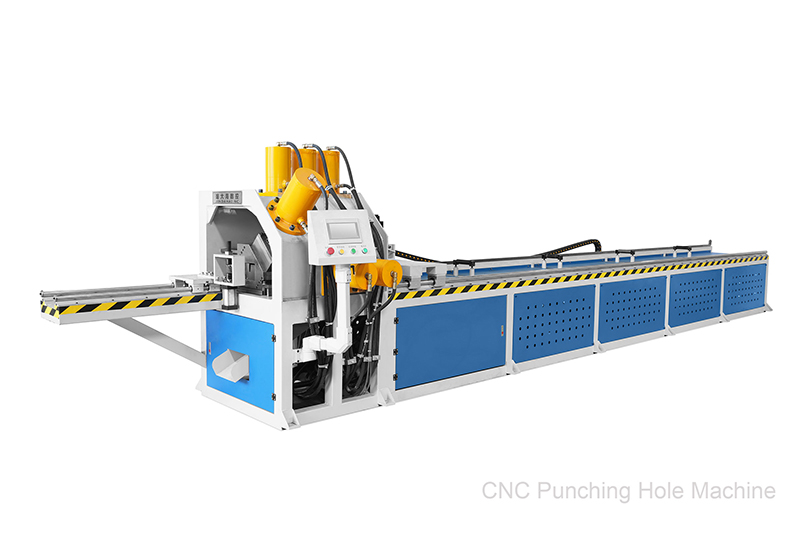
Based on the customer’s production needs, we provided a CNC punching and cutting solution designed for steel processing in the electrical equipment industry.
Instead of focusing on complicated technical specifications, the solution emphasized stable production, continuous processing capability, and improved workshop efficiency.
Key features of the solution include:
Automatic feeding workflow for continuous material processing
Integrated punching and cutting operations in one machine
Stable hydraulic punching for consistent hole dimensions
Clean cutting performance suitable for welding preparation
Dual-drive positioning for improved material movement efficiency
Heavy-duty machine structure for long-term industrial operation
This allows the customer to complete punching and cutting operations in a more streamlined workflow.
Streamlining the Production Workflow
In the upgraded production process, materials are loaded onto the feeding area in batches.
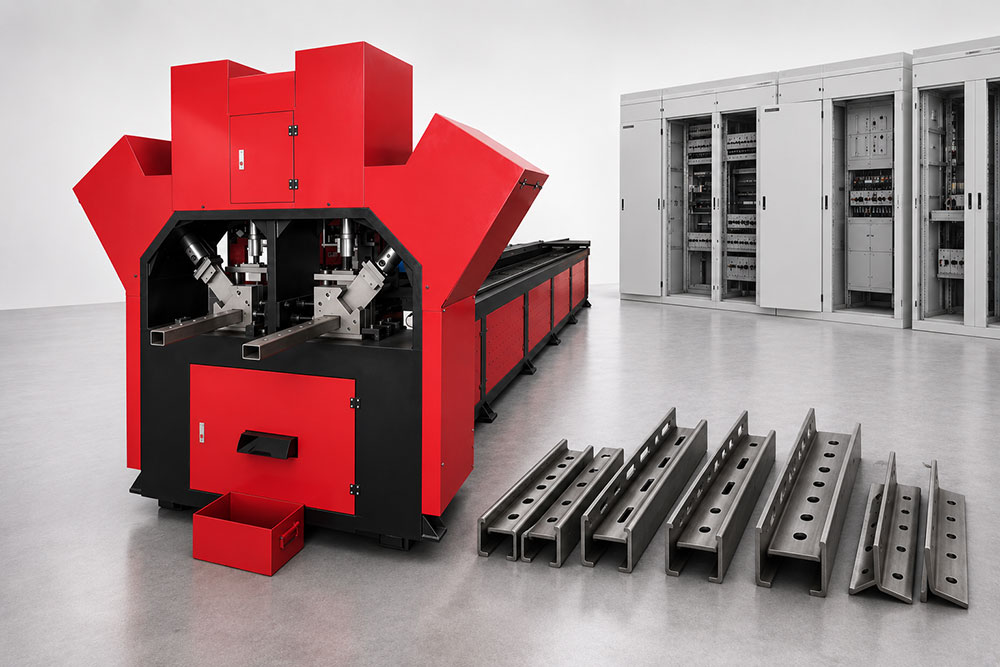
The machine automatically feeds the channel steel and angle steel into the processing area, where punching and cutting operations are completed according to the programmed dimensions.
Because the workflow is CNC controlled, the need for repeated manual marking is eliminated.
The finished parts are discharged automatically after processing, helping reduce unnecessary handling between workstations.
Compared with traditional gas cutting methods, the processed materials have cleaner cutting edges and more consistent hole positioning.
Why CNC Punching and Cutting Fits Electrical Cabinet Production
For electrical cabinet manufacturers, welding efficiency and dimensional consistency are extremely important.
Traditional gas cutting often creates rough edges and irregular holes, increasing the amount of grinding and correction work required before assembly.
By upgrading to CNC steel processing equipment, the customer improved several key production areas.
Hole positioning became more repeatable.
Cutting surfaces became cleaner and easier to weld.
Production speed increased through automated feeding and processing.
Labor dependency was reduced because fewer operators were needed.
Material flow became more organized within the workshop.
For factories processing large quantities of cabinet support structures every day, these improvements help maintain more stable production quality.
Improving Productivity and Reducing Labor Costs
One of the main goals of this project was reducing labor intensity.
Previously, multiple workers were needed for marking, gas cutting, grinding, and transferring materials between stations.
With the CNC punching and cutting system, these steps are simplified into a more automated workflow.
This helps the factory:
Reduce manual measuring work
Lower dependence on skilled gas-cutting operators
Reduce secondary grinding operations
Improve processing consistency
Increase production capacity within the same workshop area
At the same time, CNC operation improves workplace safety because operators remain separated from the main processing area during production.
Supporting Long-Term Manufacturing Stability
As demand for electrical cabinets and industrial electrical systems continues to grow, manufacturers need equipment that can support stable long-term production.
The CNC processing solution provides the flexibility to handle different steel sizes while maintaining production consistency across large batches.
For factories producing cabinet structures, industrial supports, and electrical framework components, this kind of automation helps create a more scalable production model.
The integrated punching and cutting workflow also reduces equipment switching time, helping manufacturers improve overall operational efficiency.
Conclusion
This project demonstrates how a German electrical cabinet manufacturer improved its steel processing workflow through a CNC punching and cutting system.
By replacing traditional manual marking and gas cutting operations, the factory achieved cleaner cutting quality, more consistent hole positioning, and improved production efficiency.
For manufacturers producing electrical cabinet structures and industrial steel supports, CNC automation provides a practical solution for reducing labor costs, improving welding preparation quality, and supporting long-term production growth.