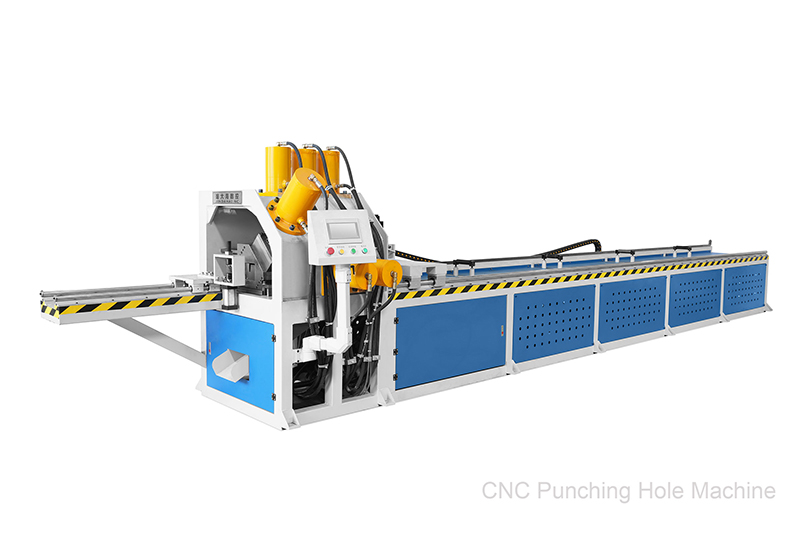
A Practical Automation Story from Manual Processing to Efficient Production
In recent years, furniture manufacturing in Eastern Europe has undergone a noticeable transformation. As market competition intensifies and labor costs continue to rise, manufacturers are no longer focused solely on output volume—they are increasingly concerned with efficiency, consistency, and long-term production stability.
This case study tells the story of a Russian furniture tube manufacturer who upgraded their production process by adopting an automated CNC laser tube cutting solution for square tube processing. Instead of relying on labor-intensive methods, the customer sought a scalable, automated approach that could support continuous growth while reducing operational pressure on workers.
Background: Furniture Tube Manufacturing in a Competitive Market
The customer is located in Russia and operates in the furniture tube manufacturing sector, supplying square and rectangular steel tubes used in:
Furniture frames
Storage racks and shelves
Display structures and support components
In this industry, dimensional accuracy and cutting consistency are essential. Even small deviations can lead to assembly issues, rework, or wasted materials—especially when tubes are processed in large batches.
Before the upgrade, the customer relied on traditional cutting and drilling methods. While functional, these processes required significant manual involvement and multiple operators per line, which limited scalability and increased long-term costs.
Production Challenges Identified
As demand increased, several bottlenecks became increasingly evident:
High Labor Dependency
Manual loading and semi-automatic cutting required constant operator attention. Skilled labor was becoming harder to recruit and retain.
Limited Production Efficiency
Processing 6-meter square tubes into shorter sections required multiple steps, slowing overall throughput.
Inconsistent Cutting Quality
Manual alignment and tool wear could affect hole positioning and cut accuracy, particularly during long production runs.
Rising Operational Costs
With increasing wage pressure, the cost per processed tube was steadily rising.
To stay competitive, the customer needed a solution that could deliver automation, precision, and efficiency—without overly complex operation or maintenance requirements.
Defining the Machine Requirements
After evaluating their production workflow, the customer outlined several key requirements for a new tube processing system:
Automated loading:
Square tubes needed to be loaded in bundles, reducing manual handling and enabling continuous operation.
Flexible cutting range:
The system had to handle both square and round tubes within a broad size range, covering current and future product needs.
Laser cutting and cut-off in one process:
The customer required precise hole cutting and length cutting in a single automated cycle.
Stable performance on medium-thickness materials:
Tubes with common furniture-grade wall thicknesses needed to be processed cleanly and efficiently.
Operator efficiency:
The goal was for one operator to supervise multiple machines simultaneously, improving labor utilization.
The Proposed Solution: Automated Laser Tube Cutting Configuration
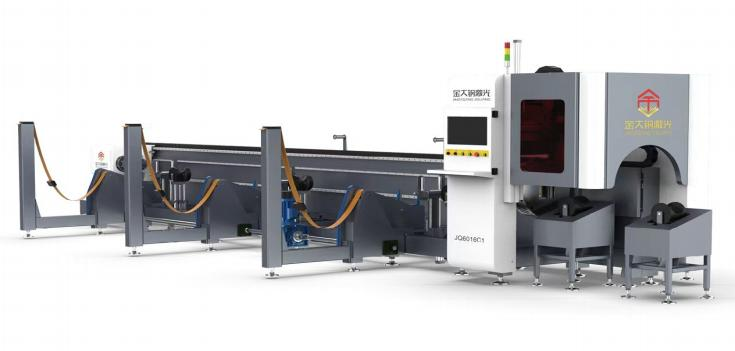
Based on the customer’s requirements, we designed a CNC laser tube cutting and cut-off solution tailored for furniture tube production.
Rather than focusing on extreme specifications, the system was configured for stable, repeatable performance in a real factory environment. Key elements of the solution included:
An automatic bundle loading system, enabling continuous feeding of square tubes without manual intervention
A precision clamping system suitable for a wide range of tube sizes, ensuring stable rotation and positioning during cutting
A fiber laser cutting unit optimized for furniture-grade steel tubes
Integrated cut-off functionality, allowing 6-meter tubes to be processed into shorter sections efficiently
A CNC control system designed for intuitive operation and reliable repeatability
This configuration allowed hole cutting and length cutting to be completed in one automated workflow.
How the Process Works: From Raw Tube to Finished Section
In daily operation, bundled square tubes are loaded onto the system and fed automatically into the cutting area. Once positioned and clamped, the machine performs laser hole cutting and length cutting according to pre-programmed parameters.
The process eliminates the need for manual measuring or repositioning between steps. Each tube follows a consistent cutting path, ensuring uniform results across batches.
For the customer’s main application, 40 × 60 mm square tubes are processed from full-length stock into shorter sections suitable for furniture assembly.

Designed for Furniture Manufacturing Efficiency
Unlike heavy structural steel applications, furniture tube production requires a balance between speed, accuracy, and surface quality. The solution was designed with this balance in mind.
Key benefits of this approach include:
Clean cutting edges suitable for direct assembly or finishing
Consistent hole positioning, critical for standardized furniture components
Reduced setup time when switching between tube sizes
Lower labor involvement, as one operator can oversee multiple machines
By automating both loading and cutting, the production line becomes more predictable and scalable.
Why Laser Tube Cutting Fits Furniture Production
For furniture manufacturers, laser tube cutting offers several advantages over traditional mechanical methods:
No physical punching force, reducing deformation on thinner tubes
Greater design flexibility for hole shapes and positions
Faster changeovers between product types
Reduced tool wear and maintenance
In this project, laser cutting provided the accuracy required for furniture frames while maintaining high processing efficiency.
A Scalable Solution for Long-Term Growth
This CNC laser tube cutting solution was not designed as a one-off upgrade. Instead, it was planned as part of a longer-term automation strategy.
As production volume grows or product types expand, the system can support:
Additional tube sizes within the same processing range
New cutting programs without mechanical modification
Integration into broader automated production lines
By focusing on practical automation rather than excessive specifications, the solution remains adaptable and cost-effective over time.
Conclusion: From Manual Processing to Automated Precision
This project demonstrates how a furniture tube manufacturer in Russia transitioned from labor-intensive processing to a more automated, efficient production model.
Through a carefully configured CNC laser tube cutting and cut-off solution, the customer achieved:
Streamlined tube processing from loading to cut-off
Reduced reliance on manual labor
Improved consistency and production efficiency
A production setup suitable for future expansion
For furniture manufacturers facing similar challenges, automated laser tube cutting offers a practical path toward higher efficiency and long-term competitiveness—without unnecessary complexity.