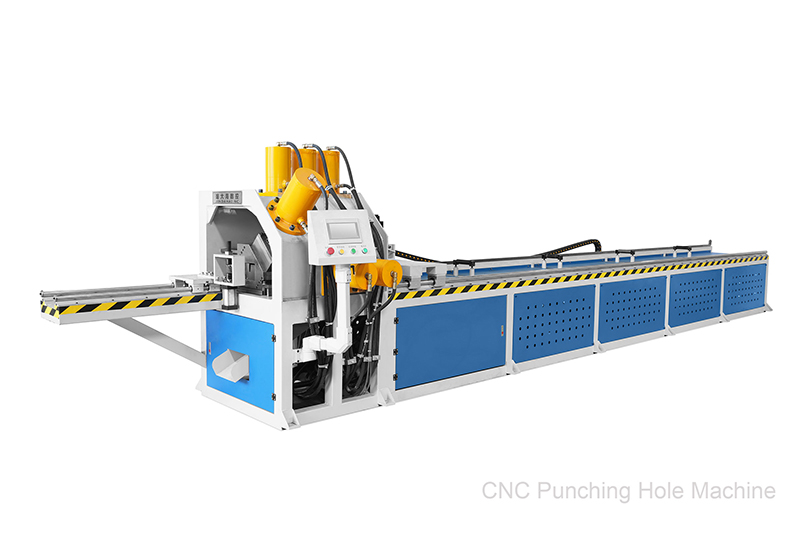
A Practical Story of Value-Added Processing for Local Customers
In Southeast Asia, small and medium-sized metal businesses are facing a shift in how they compete. Instead of relying only on material sales, many companies are moving toward **service-oriented operations**, offering simple processing services that add value for customers and strengthen long-term relationships.
This case study tells the story of a stainless steel tube wholesaler in Vietnam who introduced a **semi-automatic punching solution** to support local demand for anti-theft window grille production. The goal was not mass production, but convenience, flexibility, and on-demand processing for walk-in customers.
Customer Background: A Local Stainless Steel Tube Wholesaler
The customer is based in **Vietnam** and operates a **stainless steel tube wholesale store**. Their main business focuses on supplying square tubes to local fabricators, installers, and individual contractors.
One of the most common downstream applications of their products is **anti-theft window grilles**, widely used in residential and commercial buildings. These grilles require accurately punched holes before welding or assembly.
Rather than outsourcing hole punching or asking customers to handle processing themselves, the wholesaler identified an opportunity to provide **basic punching services directly at the point of material purchase**.
Market Context and Operational Challenges
As competition increased among material suppliers, simply offering raw tubes was no longer enough to stand out. Several practical challenges became clear:
- Customers often needed **quick hole punching** for standard square tubes
- Outsourced processing caused delays and added transportation costs
- Large-scale automated lines were unnecessary due to **low-to-medium volume demand**
- Space and budget constraints required a **compact and simple solution**
The wholesaler needed a machine that could be operated manually, occupy limited floor space, and deliver consistent punching results without complex automation.
Defining the Production Requirements
Based on daily sales and customer requests, the requirements for the punching system were clearly defined:
- Manual feeding was sufficient, as production volume was limited
- *The machine needed to support two common square tube sizes
- Hole punching had to be accurate and repeatable for anti-theft grille applications
- The system had to handle stainless steel and mild steel materials
- Operation needed to be straightforward for shop-floor use
The focus was on practicality rather than high output or advanced automation.
The Processing Task: Standardized Hole Punching for Security Grilles
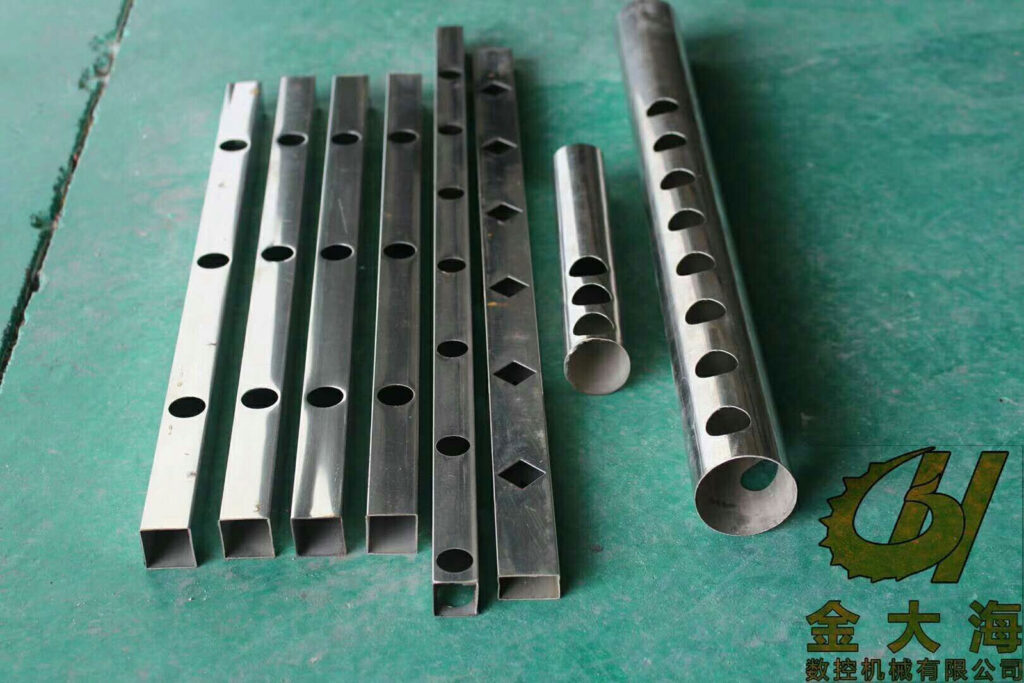
The primary processing task involved punching round holes in square tubes used for security grilles:
- Square tubes in commonly used dimensions
- A standardized round hole size suitable for grille assembly
- Consistent hole positioning to support welding and installation
These tubes are typically processed in short batches, often while customers wait or return later the same day to collect finished materials.
Solution Overview: Semi-Automatic Hydraulic Punching Configuration
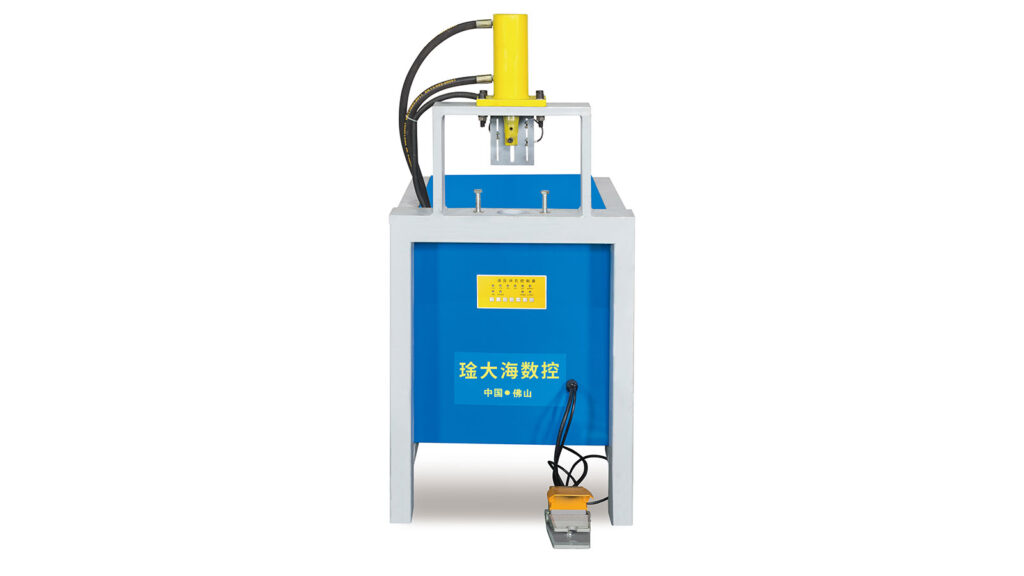
To meet these requirements, we proposed a **single-station semi-automatic hydraulic punching solution** designed for retail and light fabrication environments.
Instead of emphasizing exact specifications, the solution focused on **stable punching performance**, durability, and ease of operation. The configuration included:
- A compact gantry-style machine structure for stability and ease of alignment
- A hydraulic punching system suitable for stainless steel and mild steel tubes
- Interchangeable punching tooling designed for square tube applications
- A manual feeding workflow optimized for short production runs
This setup allowed the wholesaler to perform hole punching efficiently without the need for advanced CNC programming.
Practical Operation in a Retail Environment
In daily use, square tubes are manually positioned and aligned before punching. The operator activates the punching cycle, and the hole is formed in a single, stable motion.
Because the workflow is simple and repeatable, the machine integrates smoothly into a retail-oriented workspace, where flexibility and speed are more important than continuous mass production.
The solution supports:
- On-demand processing for walk-in customers
- Small batch production without long setup times
- Consistent hole quality across different materials
Supporting Service-Oriented Business Models
This project highlights how simple processing equipment can support a service-driven business strategy.
By offering in-house punching services, the wholesaler can:
- Reduce customers’ need to visit separate processing workshops
- Improve material turnover by bundling products with services
- Strengthen long-term cooperation with installers and fabricators
The machine acts not as a large production asset, but as a value-added service tool within the supply chain.
Why Semi-Automatic Punching Fits This Application
For low-volume and retail-based operations, semi-automatic punching offers several advantages:
- Lower investment compared to fully automated lines
- Minimal training requirements for operators
- Compact footprint suitable for shop-floor use
- Reliable performance for standard hole patterns
In this case, the semi-automatic approach provided the right balance between functionality and simplicity.
A Scalable Foundation for Future Needs
Although the current demand focuses on standard anti-theft grille tubes, the solution allows room for future adjustments:
- Additional tooling can support other square tube sizes
- The machine can adapt to different hole requirements as product demand changes
- Processing capacity can be expanded without replacing the entire system
This flexibility makes the solution suitable not only for current operations, but also for future service expansion.
Conclusion: Simple Automation for Practical Value
This case study demonstrates how a stainless steel tube wholesaler in Vietnam adopted a semi-automatic punching solution to enhance service capability rather than pursue large-scale production.
By introducing a practical, manually operated punching machine, the customer established a convenient processing service for anti-theft grille materials—supporting local fabricators while strengthening their own market position.
For material suppliers and small fabrication businesses, this project shows that simple, well-matched equipment can play a key role in transitioning toward value-added, service-oriented operations.