A Practical Automation Story Focused on Efficiency, Safety, and Zero Material Waste
As infrastructure development continues across Eastern Europe and Northern Asia, the demand for power transmission towers remains stable and highly competitive. Manufacturers serving this sector are under constant pressure to deliver large volumes of standardized components while controlling costs, improving safety, and minimizing material waste.
This case study presents a real-world application of a CNC double-side angle iron punching and cutting solution developed for a Russian power tower manufacturer. Rather than focusing on mass customization or experimental processes, this project centered on stable production, labor efficiency, and zero tail material control for angle steel components.
Industry Background: Power Tower Manufacturing in a Competitive Environment
The customer is located in Russia and operates in the power transmission tower manufacturing industry. This sector relies heavily on angle steel components, which form the structural framework of transmission towers used in power grid construction.
Angle iron used in these projects typically requires:
Precise hole punching on both sides
Multiple hole patterns on the same workpiece
Accurate length cutting from standard long bars
High repeatability across large batches
With increasing competition and tighter project margins, manufacturers are expected to deliver consistent quality while reducing dependence on manual labor.
Production Challenges Before Automation
Before upgrading their equipment, the customer relied on conventional processing methods that involved significant manual handling and multiple production steps.
Several challenges became increasingly apparent:
High Labor Cost and Workforce Pressure
Manual punching and cutting required multiple operators per line, increasing long-term labor expenses.
Production Efficiency Constraints
Processing long angle iron into multiple short sections involved repeated positioning and manual measurement.
Material Waste from Tail Ends
Traditional cutting methods often resulted in leftover material that could not be reused efficiently.
Operational Safety Risks
Close human-machine interaction increased the risk of workplace accidents during high-volume production.
To remain competitive, the manufacturer needed a more automated and controlled processing solution.
Defining the Technical Requirements
After reviewing their production workflow, the customer defined several clear requirements for a new machine configuration:
Double-side punching capability for angle iron
Support for two different hole types on opposite sides of the same profile
Integrated punching and cutting in one continuous process
Ability to process standard long-length angle bars into multiple short sections
A solution that minimizes or eliminates tail material waste
Improved safety through human–machine separation
The focus was not on extreme speed, but on repeatable accuracy, material utilization, and stable daily output.
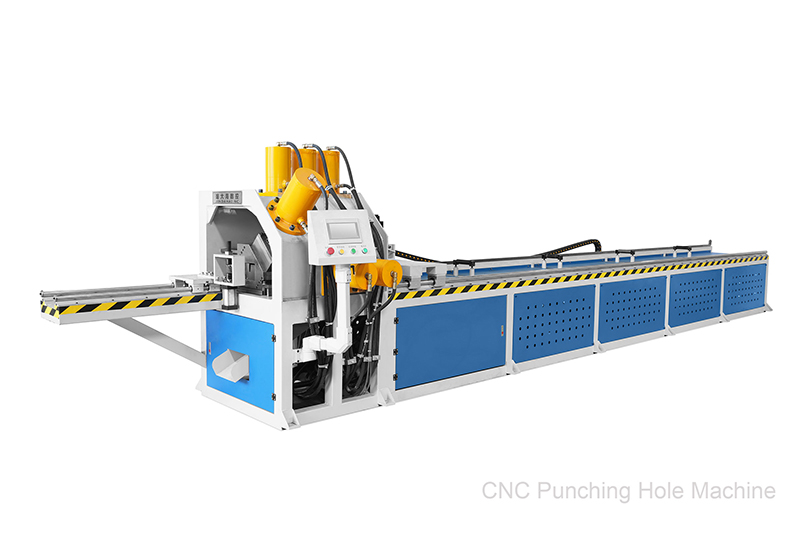
Solution Overview: Heavy-Duty CNC Angle Iron Punching and Cutting System
Based on these requirements, we developed a heavy-duty CNC angle iron punching and cutting solution specifically configured for power tower components.
Rather than emphasizing detailed numerical specifications, the solution was designed around structural strength, synchronized motion control, and reliable hydraulic performance.
Core characteristics of the solution include:
A single-station CNC configuration integrating punching and cutting functions
Multiple hydraulic punching units arranged to support double-side processing
A dedicated cutting mechanism synchronized with the punching cycle
A long-stroke feeding system suitable for full-length angle bars
A front pulling and zero-tail-material device, ensuring maximum material utilization
This configuration allows hole punching and cutting to be completed in a single, controlled workflow.
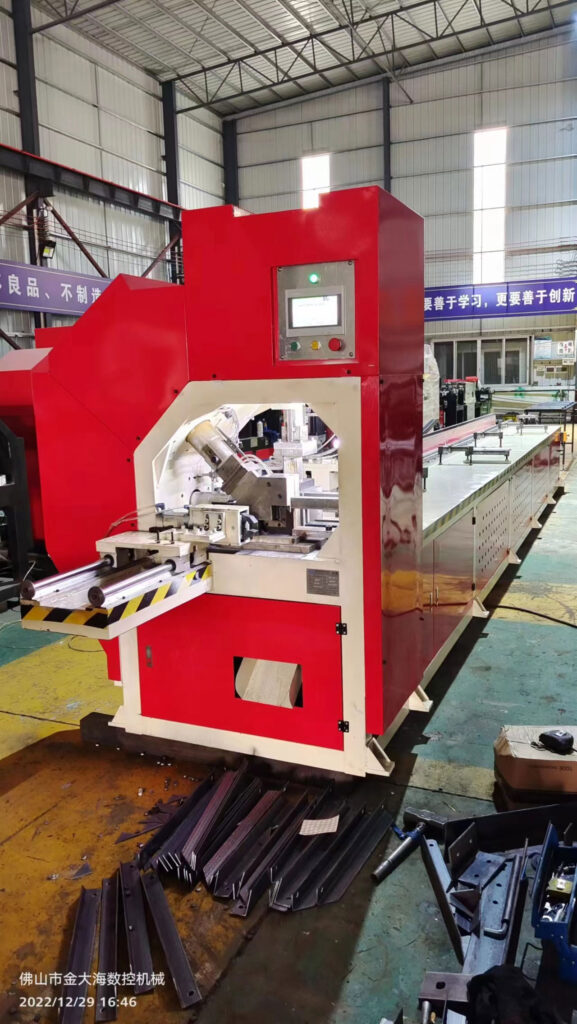
Processing Task: Double-Side Punching with Integrated Cutting
In daily operation, full-length angle iron bars are fed into the machine and positioned automatically. Once aligned, the system performs punching operations on both sides of the angle profile according to the programmed layout.
Two different hole types are applied on opposite sides, supporting the structural assembly requirements of power transmission towers.
After punching is completed, the machine performs precise length cutting, dividing the long bar into multiple finished sections. The zero-tail-material design ensures that usable material is maximized and unnecessary scrap is minimized.
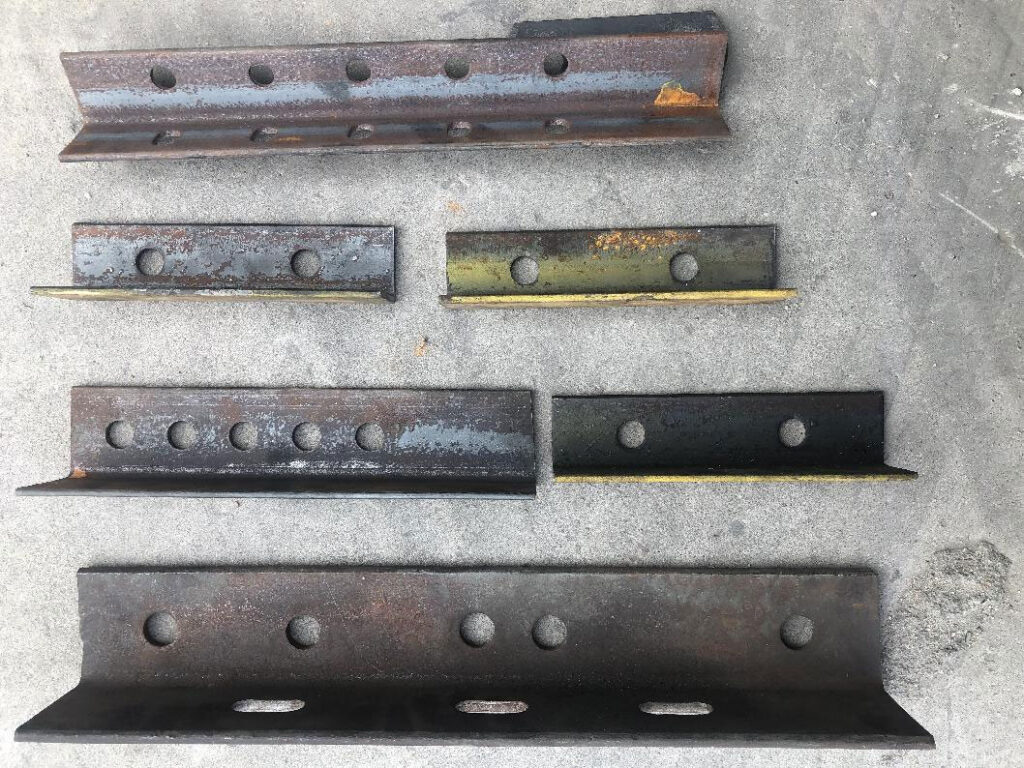
Designed for Material Efficiency and Safety
One of the key objectives of this project was to reduce material waste while improving operational safety.
The integrated feeding and cutting logic ensures:
Accurate length control for each finished piece
Reduced leftover material at the end of each bar
Consistent hole alignment across batches
At the same time, CNC control enables operators to manage the process from a safe distance, reducing direct interaction with moving components and cutting zones.
Supporting Stable, High-Volume Infrastructure Production
Power tower manufacturing demands consistency over long production cycles. This solution was designed to support:
Continuous batch processing of angle iron components
Stable hole positioning for standardized tower designs
Predictable output suitable for large infrastructure projects
By integrating punching and cutting into a single system, the production line becomes simpler and easier to manage.
Why CNC Punching and Cutting Is Suitable for Power Tower Applications
Compared with manual or semi-automatic methods, CNC-based punching and cutting offers clear advantages for this type of application:
Improved repeatability for structural components
Reduced dependency on skilled manual labor
Better control over material usage
Enhanced workplace safety
In this project, the CNC solution provided a balanced combination of automation and reliability, tailored specifically for heavy-duty angle iron processing.
A Practical Automation Strategy for Long-Term Growth
Rather than pursuing maximum automation complexity, this project focused on practical, production-oriented automation.
The system allows the manufacturer to:
Scale output without proportional increases in labor
Maintain consistent quality across large orders
Reduce waste-related costs over time
Adapt to future production planning with minimal adjustment
This makes the solution suitable not only for current power tower projects, but also for future infrastructure demands.
Conclusion: Efficient Angle Iron Processing for Competitive Power Tower Manufacturing
This case study demonstrates how a Russian power tower manufacturer upgraded its production line with a CNC double-side angle iron punching and cutting solution.
By integrating punching, cutting, and zero-tail-material control into a single system, the manufacturer achieved a more efficient, safer, and material-conscious production workflow—well aligned with the demands of modern infrastructure manufacturing.
For companies facing similar challenges in angle steel processing, this project highlights how a well-configured CNC solution can support long-term efficiency and competitiveness without unnecessary complexity.