How a Canadian Power Equipment Manufacturer Improved Connection Plate Production
As electrical infrastructure projects continue to expand across Canada and North America, manufacturers of power equipment are facing increasing pressure to deliver products faster, maintain consistent quality, and control production costs.
One Canadian manufacturer specializing in power equipment components found itself at a critical stage of growth. The company produced large quantities of flat steel connection plates used in electrical structures, support systems, and equipment installations. These components required precise hole positions and accurate cutting lengths to ensure reliable assembly on-site.
As demand increased, the company’s traditional manufacturing process began creating production bottlenecks. To remain competitive, they needed a more efficient production solution.
The Challenge: Multiple Operations for One Simple Part
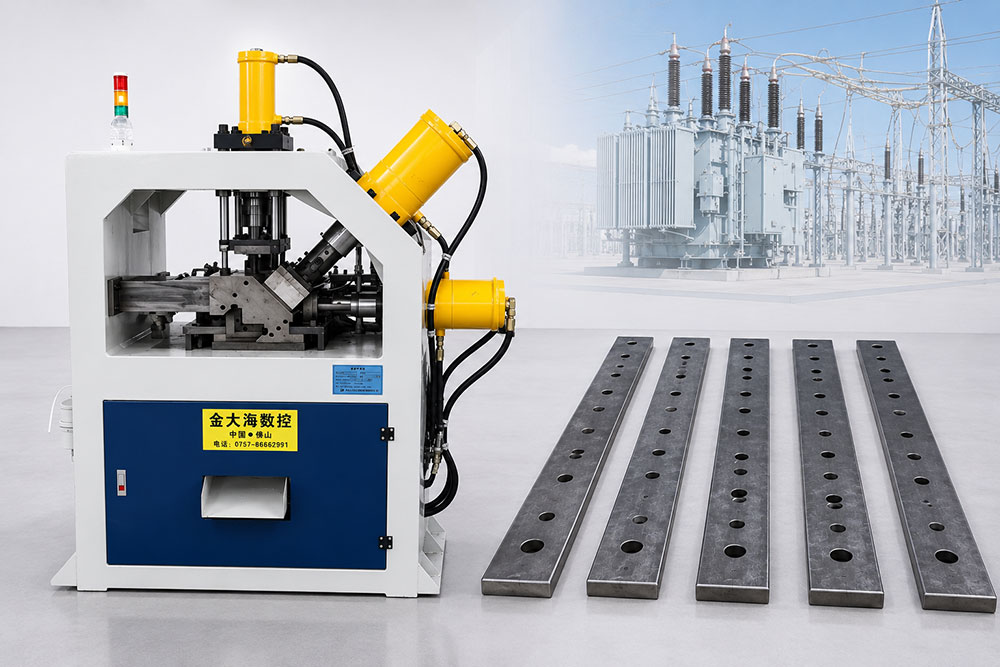
The customer’s primary product was a flat steel connection plate manufactured from long flat bars.
Each finished component required multiple holes of different diameters followed by accurate cutting into individual pieces.
Although the product itself appeared simple, the production process was not.
The traditional workflow involved several separate steps:
Manual positioning of flat steel material
Punching holes in multiple operations
Transferring materials between workstations
Measuring and cutting individual pieces
Sorting finished parts
As production volumes increased, these repeated operations consumed valuable labor hours and slowed down overall throughput.
In addition, every material transfer introduced opportunities for dimensional errors, reducing production efficiency and increasing manufacturing costs.
Why Traditional Processing Was Limiting Growth
For power equipment manufacturers, consistency is critical.
Connection plates must maintain accurate dimensions and hole locations to ensure smooth assembly during installation.
However, when multiple production steps are involved, maintaining consistent quality becomes more difficult.
The customer identified several challenges:
Rising labor costs
Increasing order volumes
Long production cycles
Material waste during processing
Production safety concerns
Difficulty expanding capacity without hiring additional workers
They needed a solution that could combine punching and cutting into one automated workflow.
Searching for a More Efficient Manufacturing Solution
The customer began evaluating equipment capable of producing connection plates with fewer manual operations.
Their objectives were clear:
Complete punching and cutting on one machine
Improve production speed
Reduce labor dependency
Increase production consistency
Minimize material waste
Improve workplace safety
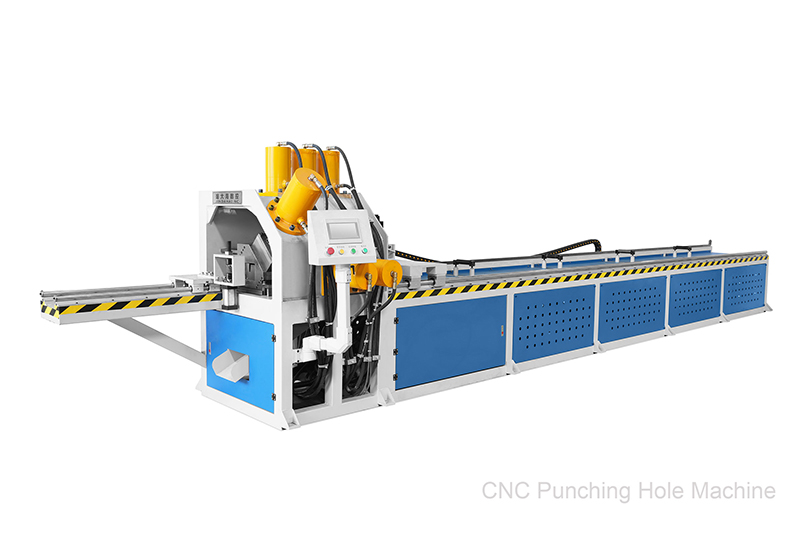
After reviewing the production requirements, we recommended a customized CNC punching and cutting machine designed specifically for flat bar processing.
Our Recommended Solution
The proposed solution focused on integrating multiple production steps into a single automated workflow.
Instead of processing materials through separate punching and cutting stations, the machine performs all required operations in sequence.
Long flat bars are loaded onto the feeding section.
The machine automatically positions the material according to programmed dimensions.
Multiple holes can be punched simultaneously before the material is automatically cut into finished connection plates.
The production process becomes:
Material Loading → Automatic Feeding → Hole Punching → Cutting → Finished Part Output
This approach significantly reduces handling time and improves overall production efficiency.
Key Advantages for Power Equipment Manufacturing
The benefits of automation extend far beyond simple productivity improvements.
For manufacturers supplying electrical infrastructure projects, consistency, efficiency, and reliability are equally important.
Higher Production Efficiency
The integrated workflow eliminates unnecessary material transfers between different machines.
Multiple operations are completed in a single cycle, allowing production to move faster while maintaining accuracy.
Reduced Labor Costs
Automated feeding and positioning reduce the amount of manual work required.
Instead of multiple operators handling separate processes, production can be managed more efficiently with fewer personnel.
Improved Dimensional Consistency
Accurate positioning ensures every connection plate is produced according to programmed specifications.
This helps maintain consistent hole locations and cutting lengths across large production batches.
Less Material Waste
Optimized material handling and precise positioning help reduce scrap generation.
For manufacturers processing large quantities of flat steel every month, material savings contribute directly to lower production costs.
Enhanced Workplace Safety
Traditional punching and cutting operations often require workers to remain close to moving materials and processing areas.
With automated processing, operators can supervise production from a safer distance, reducing exposure to potential workplace hazards.
Better Scalability
As project volumes increase, automated production allows manufacturers to expand output without proportionally increasing labor requirements.
This provides a practical path toward long-term growth.
Supporting the Future of Power Equipment Manufacturing
The electrical industry continues to demand faster delivery schedules and more competitive pricing.
Manufacturers that rely heavily on manual production methods often struggle to keep pace with these changing market requirements.
By implementing a modern flat bar punching machine solution, the customer created a more streamlined manufacturing process capable of supporting future business growth.
The ability to produce multiple hole patterns and complete cutting operations within a single workflow provides a significant advantage for connection plate manufacturing.
A Smarter Way to Produce Connection Plates
This project demonstrates how automation can simplify the production of power equipment components.
By replacing multiple manual operations with an integrated automatic punching production line, the manufacturer improved workflow efficiency while reducing labor dependency and material waste.
For companies producing connection plates, support brackets, and other electrical infrastructure components, integrated punching and cutting technology offers a practical way to improve productivity while maintaining consistent quality.
Building a More Competitive Production Process
As competition continues to increase throughout the power equipment industry, manufacturers must constantly look for ways to improve efficiency and reduce operating costs.
Automated production solutions help companies achieve these goals by reducing manual intervention, improving consistency, and creating a more scalable manufacturing platform.
For this Canadian manufacturer, upgrading from a traditional multi-step process to a modern CNC production system represented an important step toward greater competitiveness and future growth.
Conclusion
The Canadian power equipment manufacturer needed a more efficient way to produce flat steel connection plates while reducing labor costs and improving production consistency.
By implementing a customized CNC punching machine solution, the company streamlined its workflow, combined multiple operations into one automated process, improved safety, and reduced material waste.
For manufacturers involved in electrical infrastructure projects, connection plate production, and power equipment fabrication, automated punching and cutting technology provides a reliable path toward higher productivity and long-term manufacturing success.