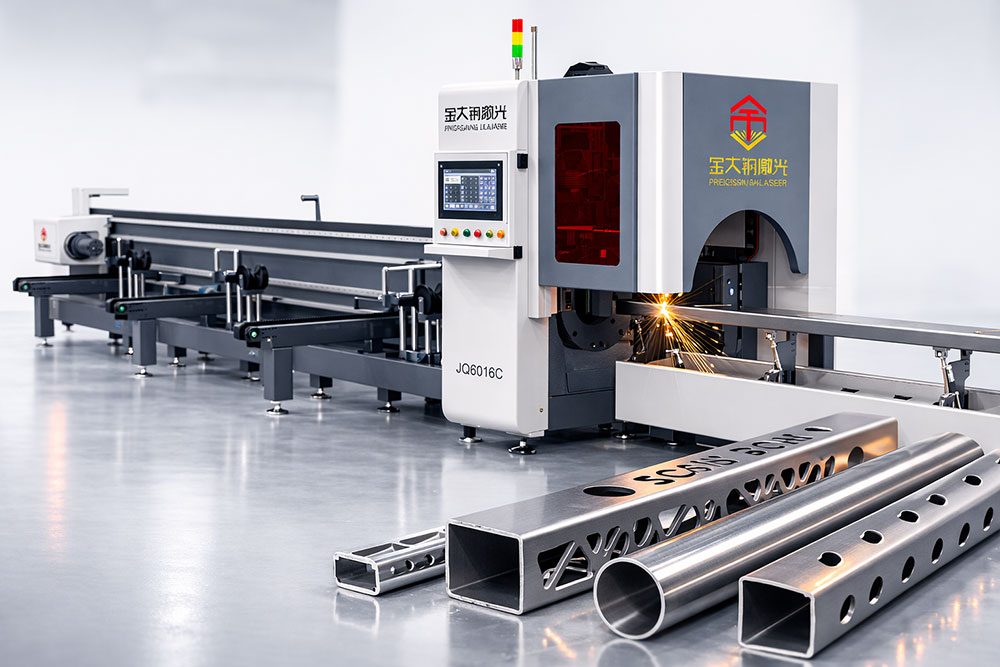
Modern manufacturing depends on speed, accuracy, and flexibility. As product designs become more complex and delivery times become shorter, metal fabricators are under increasing pressure to improve efficiency without sacrificing quality. This is one reason why the laser tube cutting machine has become such an important solution in today’s fabrication industry. Instead of relying on multiple traditional processes, manufacturers can use one intelligent system to cut tubes and profiles with better precision and much higher productivity.
A tube laser cutting machine is now widely used in industries such as construction, furniture, automotive parts, fitness equipment, agricultural machinery, and metal structure fabrication. It helps companies process round tubes, square tubes, rectangular tubes, and many other profiles with clean edges and highly consistent results. In this guide, we will explain what a laser tube cutting machine is, where it is used, how it works, how factories use it in real production, and why it brings so much value to industrial manufacturing.
What Is a Laser Tube Cutting Machine?
A laser tube cutting machine is a CNC-controlled metal fabrication system designed to cut tubes, pipes, and structural profiles using a focused laser beam. Most modern machines use fiber laser technology because it offers high energy efficiency, strong cutting ability, stable performance, and lower maintenance compared with older laser systems.
Unlike traditional cutting equipment that may only handle straight cuts, a fiber laser tube cutting machine can process many different shapes and features in one setup. It can cut holes, slots, contours, bevels, notches, and complex end profiles directly on metal tubes. This makes it much more versatile than sawing, drilling, or manual marking and cutting.
The machine is controlled through software and a CNC system, which means the cutting path is based on digital programming rather than manual positioning. Once a drawing is prepared, the operator can run repeated jobs with very high consistency. For manufacturers that need accurate production, faster setup changes, and lower labor dependence, this technology offers a major advantage.
In simple terms, a laser tube cutting machine allows fabricators to turn raw metal tubes into ready-to-assemble parts with fewer manual steps and better overall efficiency.
What Materials and Profiles Can It Process?
One of the reasons this technology is so widely adopted is its ability to process a broad range of materials and shapes. A modern metal tube cutting machine can work with carbon steel, stainless steel, aluminum, galvanized steel, and in some cases other metal alloys, depending on the machine configuration and laser power.
It is also suitable for many profile types. Round tubes and square tubes are the most common, but the machine can also handle rectangular tubes, oval tubes, angle steel, channel steel, and other special-shaped metal profiles. That makes it useful for factories producing both standard and customized products.
This broad processing range is important because many manufacturers do not work with just one tube type. A company making furniture frames may need square tubes and round tubes in the same order. A construction supplier may work with rectangular tubing and angle steel. A machine that can switch between these materials and profiles with minimal changeover adds significant production flexibility.
A tube profile cutting machine is especially valuable when a factory has mixed orders, frequent specification changes, or product lines that require complex profile processing. Instead of buying separate equipment for different shapes, many manufacturers prefer one integrated solution that can handle multiple tasks efficiently.
Where Is It Used in Different Industries?
The market application of the laser tube cutting machine is much wider than many people expect. It is not limited to one type of fabrication shop. In fact, it is used across a broad range of industries where metal tubes and profiles play a structural or decorative role.
Construction and Steel Structure
In construction-related manufacturing, the machine is used to produce handrails, support structures, scaffold components, steel frames, curtain wall supports, and architectural metal parts. These applications often require accurate dimensions and clean cutting edges because the parts need to fit well during installation.
Furniture Manufacturing
In furniture production, a tube laser cutting machine is commonly used for table legs, chair frames, shelving systems, bed frames, cabinets, wardrobes, and office furniture structures. Since modern furniture often combines function with appearance, precision and cut quality are especially important.
Automotive Components
The automotive supply chain uses tube laser cutting solutions for exhaust pipes, seat supports, structural frames, chassis brackets, and other components that require repeatable accuracy. Automotive production demands stable quality, which is why laser technology is highly attractive in this field.
Fitness Equipment
Fitness equipment manufacturers often process a large number of metal tubes with shaped ends, holes, slots, and angled cuts. Products such as gym frames, weight machine supports, and sports equipment structures are ideal applications for a CNC tube laser cutting machine.
Agricultural and Industrial Equipment
Agricultural machinery, warehouse systems, industrial brackets, display racks, lighting structures, and mechanical frames also benefit from this technology. Wherever tubes are used as a core structural material, there is a good chance that a laser tube cutting machine can improve the manufacturing process.
How Does a Laser Tube Cutting Machine Work?
To understand the value of this equipment, it helps to understand its working principle. A CNC laser tube cutting machine combines a fiber laser source, a cutting head, a clamping and rotating system, a CNC control platform, and specialized software.
The process starts when a tube is loaded into the machine. Depending on the production setup, loading may be done manually or through an automatic loading system. Once the tube is in place, the chuck or clamping mechanism holds it firmly and rotates it according to the programmed cutting path.
The laser beam is generated by the laser source and transmitted to the cutting head, where it is focused into a very small point on the metal surface. Because the energy concentration is extremely high, the material at that point melts or vaporizes. Assist gas such as oxygen, nitrogen, or compressed air then blows away the molten material and helps form the final cut.
At the same time, the CNC system coordinates the movement of the cutting head, the rotation of the tube, the cutting speed, and the piercing process. This allows the machine to create straight cuts, holes, slots, and complex contours with a high degree of accuracy.
The software is also a key part of the system. It converts part drawings into cutting programs and helps optimize the material usage. In advanced models, the system may include functions such as automatic centering, seam recognition, remnant management, intelligent nesting, and collision avoidance. These features improve both cutting quality and overall production efficiency.
How Is It Used in Daily Production?
In day-to-day factory operations, the use of a laser tube cutting machine usually begins with design preparation. The engineering team creates or imports a drawing, and the operator selects the correct material type, wall thickness, tube dimensions, and cutting parameters.
After the program is ready, raw tubes are loaded into the machine. In smaller workshops, this may still be done by hand. In larger or more automated factories, automatic tube loading systems are often used to reduce labor and improve throughput. Once the tube is clamped, the machine checks the position and starts cutting according to the digital program.
During operation, the role of the operator is very different from that of someone using traditional equipment. The operator is not manually measuring, marking, or guiding every cut. Instead, the operator monitors the machine status, gas supply, loading flow, cutting performance, and finished-part quality. This reduces manual workload while improving process consistency.
After cutting, the finished parts move to the next stage, such as welding, bending, assembly, or surface treatment. Because the parts are more accurate and cleaner, the downstream process usually becomes easier. Less rework is needed, and assembly alignment is more stable. In practical production terms, the machine improves more than just the cutting section. It supports better workflow throughout the entire manufacturing chain.
For repeat orders, saved programs allow the factory to restart production quickly without rebuilding the process from zero. For custom jobs, design changes can often be handled by updating the software rather than changing physical tooling. This makes the tube laser cutting machine especially useful for modern factories that need both speed and flexibility.
What Are the Main Benefits for Industrial Production?
The value of a laser tube cutting machine becomes even clearer when we look at the specific benefits it brings to industrial production.
Higher Production Efficiency
Traditional tube processing often requires multiple steps such as sawing, drilling, punching, and trimming. Each step takes time, uses labor, and introduces possible positioning errors. By contrast, a laser pipe cutting machine can combine several of these operations into one integrated process.
That means shorter production cycles, faster order completion, and fewer internal transfers between workstations. For manufacturers handling large orders or tight deadlines, this efficiency can make a major difference.
Lower Labor Dependence
Labor costs and labor shortages are major concerns in many manufacturing markets. A laser tube cutting machine reduces the need for several operators working on separate processes. In many cases, one trained operator can manage the machine and oversee continuous production.
This not only lowers labor intensity but also helps factories reduce dependence on highly manual work. For businesses trying to modernize their workshop or reduce safety risks, this is a very practical advantage.
Better Cutting Accuracy
High accuracy is one of the strongest selling points of precision tube laser cutting. The digital control system ensures consistent positioning and repeatable cutting results, which is essential when parts need to fit precisely in welding fixtures or assembly systems.
Better cutting accuracy means less correction work later. It also improves product appearance and dimensional reliability, which is particularly important in export manufacturing and premium product categories.
Less Secondary Processing
Traditional cutting methods often leave burrs, rough edges, inconsistent hole positions, or uneven cut surfaces. These issues create extra work in grinding, re-drilling, fitting, or manual adjustment. A laser tube cutting machine reduces many of these problems by producing cleaner cuts and more stable dimensions.
As a result, factories can reduce secondary processing time and improve production flow. In industries where time and labor are closely tied to profit, that can significantly improve cost performance.
More Flexible Manufacturing
A major reason for the growing popularity of the tube laser cutting machine is its flexibility. Modern manufacturing increasingly requires smaller batches, customized designs, and quick product updates. A laser system supports these needs much better than equipment that depends heavily on dedicated tooling.
Because the cutting program is digital, it is easier to switch between parts, update dimensions, and respond to customer changes. This makes the machine highly valuable for companies that serve multiple industries or handle frequent custom orders.
Why Is Laser Tube Cutting Better Than Traditional Methods?
Traditional methods such as band sawing, drilling, milling, punching, and manual layout still exist in many workshops, but they often show clear limitations when product complexity and quality requirements increase.
First, traditional processing usually separates cutting and hole-making into different stages. This creates more part handling, more setup time, and more room for cumulative error. If the tube is not positioned exactly the same way on every machine, the final dimensions may drift. Even a small deviation can create problems during welding and assembly.
Second, many traditional methods depend on jigs, molds, or special fixtures. These tools take time and money to prepare, and they reduce flexibility when orders change frequently. A laser pipe cutting machine avoids much of this problem because geometry changes can often be made through programming rather than through new tooling.
Third, manual methods are more dependent on worker skill and attention. Experienced operators can produce good results, but repeatability may still vary across shifts or production batches. A CNC laser tube cutting machine provides much more stable output because it follows the same programmed logic every time.
This does not mean traditional equipment has no use at all. For very simple jobs or low-budget situations, older methods may still be acceptable. However, for manufacturers focused on efficiency, repeatability, product image, and long-term competitiveness, laser cutting offers a stronger overall production solution.
Why Precision Matters in Tube Fabrication
Precision is not just a technical detail. It has a direct impact on manufacturing quality, assembly speed, and customer satisfaction. When a tube is cut inaccurately, the problem often appears later in the process. A hole may not line up with another component. A joint may not fit correctly for welding. A frame may become slightly twisted during assembly.
These issues create hidden costs. Workers spend more time adjusting parts by hand. Welders need to compensate for bad fit-up. Assemblers may struggle to maintain product consistency. Even if the part is eventually corrected, the extra time reduces production efficiency and increases labor cost.
This is why precision tube laser cutting is so valuable in industries that require repeatable quality. It helps protect the accuracy of the design from the beginning of the process. The more accurate the cut, the smoother the next production stages become.
Precision also affects visual quality. In furniture, fitness equipment, and decorative metal products, visible gaps, rough cut marks, or misaligned joints can weaken customer confidence in the final product. A laser tube cutting machine supports both structural quality and better appearance, which is increasingly important in competitive markets.
Is It Suitable for Small and Medium-Sized Businesses?
Many people assume that only very large factories can benefit from a laser tube cutting machine, but that is no longer true. Small and medium-sized businesses can also gain real value from this technology, especially if they handle multiple tube sizes, custom projects, or precision-focused orders.
The real question is not company size. The real question is whether the production process would benefit from faster cutting, fewer manual steps, better repeatability, and easier design changes. For many small and medium-sized workshops, the answer is yes.
A company that outsources tube processing may bring work in-house and gain better control over lead time and quality. A workshop that struggles with labor shortages may reduce its dependence on manual processing. A growing manufacturer may improve its image and production capability by moving to laser tube cutting technology.
Of course, buyers still need to consider investment cost, production volume, floor space, operator training, software usability, and after-sales support. But in practical terms, many smaller factories are now strong candidates for a laser tube cutting machine, especially if they want to compete on quality and delivery rather than only on low price.
How to Choose the Right Laser Tube Cutting Machine
Choosing the right machine requires more than comparing laser power alone. A good purchase decision starts with understanding your own production needs.
The first factor is tube range. You should know the round tube diameters, square tube sizes, rectangular profiles, and material thicknesses you process most often. The machine must match your main workload, not just your ideal future workload.
The second factor is material type. Stainless steel, carbon steel, aluminum, and galvanized tube may require different cutting settings and production priorities. Buyers should make sure the fiber laser tube cutting machine they choose is suitable for their material mix.
The third factor is automation level. Some factories only need a basic manual loading setup, while others need automated feeding and higher continuous output. If your order volume is growing, features such as automatic loading systems may be worth serious consideration.
Software is another major point. A machine with strong hardware but difficult software can still become inefficient in daily use. The best tube laser cutting machine is one that your team can operate smoothly, program easily, and maintain with confidence.
Finally, service and technical support should never be ignored. Installation guidance, operator training, spare parts supply, and troubleshooting response all affect long-term machine performance. A reliable supplier helps protect your investment and reduces production risk.
The Future of Tube Laser Cutting in Manufacturing
The future of manufacturing is moving toward automation, digital control, and smarter production management. In this environment, the laser tube cutting machine is becoming more than just a cutting tool. It is becoming part of a connected manufacturing system.
More factories are now integrating tube laser equipment with automatic loading, unloading, sorting, and digital production tracking. This makes it easier to manage job flow, reduce idle time, and improve production planning. The machine becomes part of a larger efficiency strategy rather than a single stand-alone workstation.
Software improvements are also expanding what manufacturers can do. Faster programming, better nesting, smarter process databases, and remote diagnostics all make the CNC tube laser cutting machine easier to operate and more efficient to manage.
At the same time, the market continues to demand shorter lead times, more customization, and better finished-product quality. These trends all favor laser processing. A system that can adapt quickly to new designs without changing physical tooling will remain highly valuable in the years ahead.
For manufacturers planning long-term growth, investing in better tube processing is not only about cutting faster. It is about building a more capable, flexible, and competitive production system.
Conclusion
A laser tube cutting machine has become one of the most practical and valuable technologies in modern metal fabrication. It is used across many industries because it combines speed, precision, automation, and flexibility in a way that traditional tube processing methods often cannot match.
Whether a manufacturer produces construction components, furniture frames, automotive parts, fitness equipment, or custom metal structures, a tube laser cutting machine can simplify the process and improve overall production quality. It helps reduce labor dependence, shorten production cycles, lower error rates, and support more efficient downstream assembly.
As manufacturing continues to evolve, businesses need equipment that can respond to higher customer expectations and more competitive market conditions. That is exactly where the laser tube cutting machine stands out. For companies looking to improve tube and profile processing, understanding this technology is the first step toward smarter and more modern production.