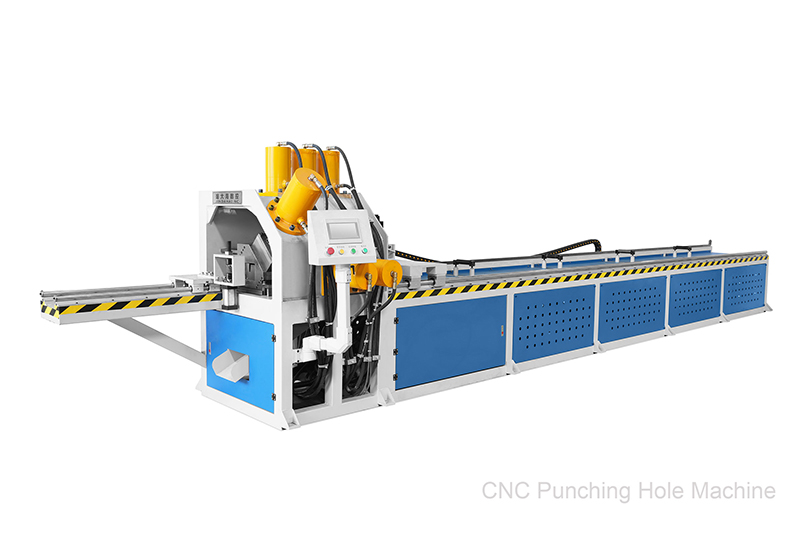
The demand for security fencing continues to grow across Africa as governments, schools, residential developments, and infrastructure projects invest in safer and more durable perimeter protection systems.
In Congo, one fencing manufacturer specializing in school fences, municipal barriers, and residential security fencing faced increasing pressure to improve production efficiency while keeping manufacturing costs under control.
The company processed multiple square tube specifications every day, including fence posts, cross rails, and structural support members. These components required different punching patterns and cutting lengths before assembly.
As order volumes increased, traditional fabrication methods began creating bottlenecks throughout the workshop. To remain competitive and improve production capacity, the company started searching for a more automated processing solution.
After evaluating several options, they selected a customized CNC fence punching machine capable of integrating punching and cutting operations into a single automated workflow.
The Growing Challenges of Fence Manufacturing
Fence production may appear simple from the outside, but manufacturers often deal with a wide range of tube sizes, hole patterns, and product designs.
The customer produced fencing systems for several markets:
School security fencing
Municipal infrastructure fencing
Residential and commercial perimeter fencing
Construction project barriers
Different fence systems required different processing requirements.
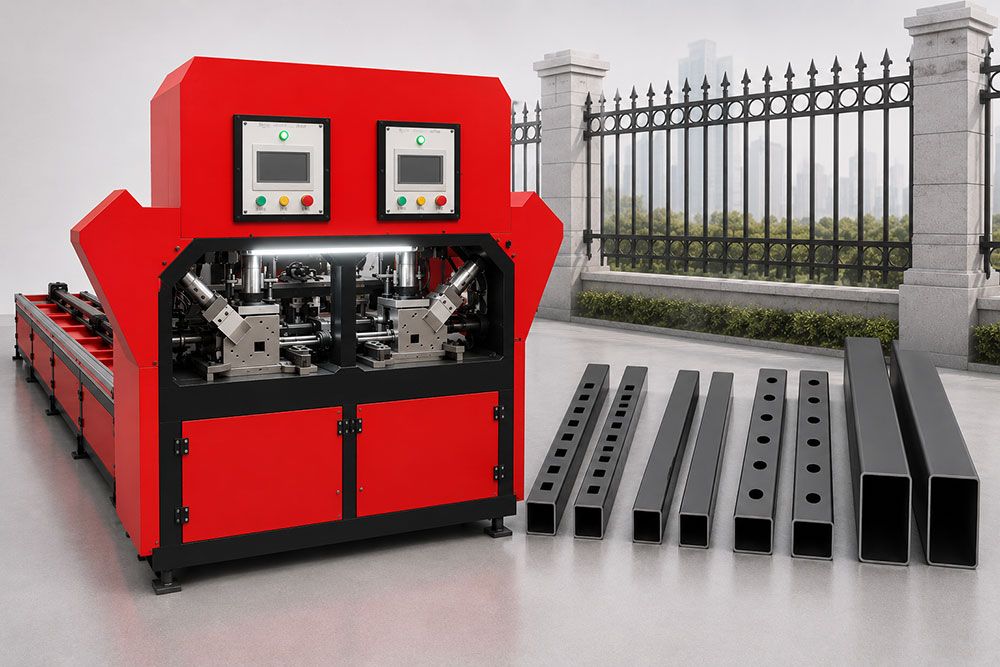
Some square tubes required square holes for assembly components.
Others required round holes for fasteners and brackets.
Larger square tubes only required accurate cutting without punching.
Previously, production relied on conventional fabrication methods involving multiple independent processes.
Materials were measured manually.
Punching operations were performed separately.
Cutting required additional handling.
Finished parts were moved between workstations.
As production volumes increased, these processes consumed significant labor and slowed production output.
Why Automation Became Necessary
The customer identified several challenges affecting production efficiency.
Manual positioning reduced consistency.
Multiple processing steps increased handling time.
Production output depended heavily on operator experience.
Labor costs continued rising.
Large fencing projects required faster delivery times.
For fence manufacturers, delivery speed often determines competitiveness in project bidding.
The company needed a production system capable of supporting higher volumes without requiring additional workers.
At the same time, product consistency needed to improve to ensure smoother assembly during fence installation.
Defining the Equipment Requirements
After reviewing their production process, the customer outlined several key objectives.
The new system needed to process multiple square tube sizes.
Punching and cutting had to be completed within one workflow.
The machine needed to support different hole shapes and configurations.
Automatic feeding was required to reduce manual handling.
The customer also wanted a system capable of maintaining stable production during long operating hours.
Because different fence products required different processing operations, flexibility was a critical requirement.
The solution needed to support multiple production scenarios without constant machine adjustments.
The Proposed CNC Solution
Based on these requirements, we developed a customized square tube punching and cutting machine specifically designed for fence manufacturing applications.
Rather than focusing on excessive technical complexity, the solution emphasized production efficiency, flexibility, and long-term reliability.
The system incorporated:
Integrated punching and cutting operations
Automatic feeding workflow
Dual-drive processing structure
Multiple punching stations
Independent control architecture
Heavy-duty machine frame
Flexible tooling configurations
This configuration allowed the customer to process multiple fence products using a single production platform.
Streamlining Fence Production
The upgraded workflow simplified production significantly.
Operators load square tubes onto the feeding rack.
The system automatically positions the material according to programmed dimensions.
Punching operations are completed automatically.
Cutting is performed within the same workflow.
Finished components are discharged automatically.
The overall process can be summarized as:
Automatic Feeding → Punching → Cutting → Automatic Discharge
By eliminating repeated material transfer between machines, production becomes more organized and efficient.
This streamlined workflow is especially valuable when manufacturing large quantities of fencing components for infrastructure projects.
Why This Solution Fits the Fence Industry
Fence manufacturers face unique production challenges compared with many other metal fabrication industries.
Projects often involve thousands of identical parts.
Consistency is critical for assembly.
Delivery deadlines are usually tight.
Material utilization directly impacts profitability.
By adopting automated fence production equipment, the customer improved multiple areas of operation.
Reduced Labor Dependency
Traditional fence production often requires several operators across different workstations.
With automated feeding and processing, fewer workers are needed to achieve the same production output.
Faster Production Cycles
Punching and cutting are completed within one machine instead of multiple stations.
This reduces material handling time and increases throughput.
Improved Product Consistency
Automatic positioning helps maintain uniform hole placement and cutting dimensions.
Consistent components simplify fence assembly and installation.
Better Workshop Organization
Reducing material movement between stations creates a more organized production environment and lowers the risk of production delays.
Enhanced Safety
The CNC system improves human-machine separation during operation.
Operators spend less time interacting directly with moving tooling and materials.
Lower Manufacturing Costs
By combining multiple processes into one production workflow, manufacturers can reduce labor costs, improve efficiency, and maximize equipment utilization.
Supporting Future Business Growth
The fencing market continues to expand as urban development, infrastructure projects, and public safety investments increase throughout many regions.
For manufacturers, the ability to produce larger volumes without dramatically increasing labor costs is becoming a major competitive advantage.
The CNC punching and cutting solution provides a scalable production platform capable of supporting future growth.
Its flexible tooling structure also allows manufacturers to adapt to changing product requirements without investing in entirely new production lines.
For companies producing school fencing, municipal barriers, and residential security systems, automation provides a practical path toward long-term competitiveness.
Conclusion
This project demonstrates how a fencing manufacturer in Congo modernized its production process through a customized CNC punching and cutting solution.
By integrating punching and cutting into a single automated workflow, the company reduced labor requirements, improved production consistency, and increased manufacturing efficiency.
For fence manufacturers producing square tube security barriers, municipal fencing systems, and residential perimeter fencing, CNC automation offers an effective way to improve productivity, reduce operating costs, and support future business growth.