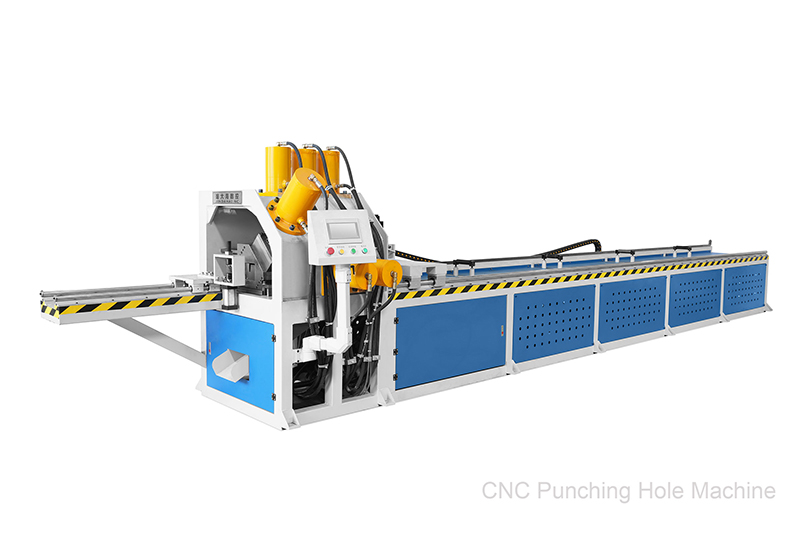
How an Indonesian Manufacturer Improved Aluminum Formwork Production
As construction projects continue growing across Southeast Asia, demand for aluminum formwork systems has increased significantly. Contractors are seeking faster construction methods, higher project quality, and reusable formwork systems that reduce overall building costs.
In Indonesia, one manufacturer specializing in aluminum formwork products faced increasing pressure to improve production efficiency while maintaining product quality.
Their factory primarily produced high-strength alloy steel formwork components, including U-shaped panels used in various construction applications. As order volumes increased, the limitations of their traditional cutting process became increasingly obvious.
To remain competitive, the company began searching for a more efficient cutting solution.
The Challenge of Traditional U-Panel Cutting
The customer’s production line included cold-formed U-shaped panels with widths ranging up to 200mm.
Previously, cutting operations relied heavily on manual handling and conventional cutting equipment.
While the process was functional, several issues limited production efficiency.
Workers needed to manually position each panel before cutting. Frequent adjustments increased production time and reduced throughput.
In addition, cut quality often varied depending on operator experience and material positioning.
Several common production challenges emerged:
Time-consuming manual loading and positioning
Inconsistent cutting accuracy
Uneven cut edges
Material waste caused by cutting deviations
Growing labor requirements as production volumes increased
Difficulty meeting delivery schedules during peak demand periods
As more construction projects adopted aluminum formwork systems, these issues became increasingly difficult to ignore.
Why Aluminum Formwork Manufacturers Need Greater Precision
Unlike conventional building materials, aluminum formwork systems require high dimensional consistency.
Every component must fit accurately during assembly at construction sites.
Poor cutting accuracy can result in:
Installation delays
Alignment issues
Additional labor costs
Increased material waste
Reduced project efficiency
For manufacturers serving construction contractors and developers, maintaining consistent quality is essential.
The customer needed a production solution capable of improving both productivity and cutting accuracy without significantly increasing labor requirements.
Evaluating a New Production Strategy
After reviewing the customer’s production requirements, our engineering team analyzed the characteristics of the U-shaped panels and the expected production volume.
The goal was not only faster cutting.
The customer also needed:
Stable production quality
Improved dimensional consistency
Reduced operator workload
Lower manufacturing costs
Flexibility for future production growth
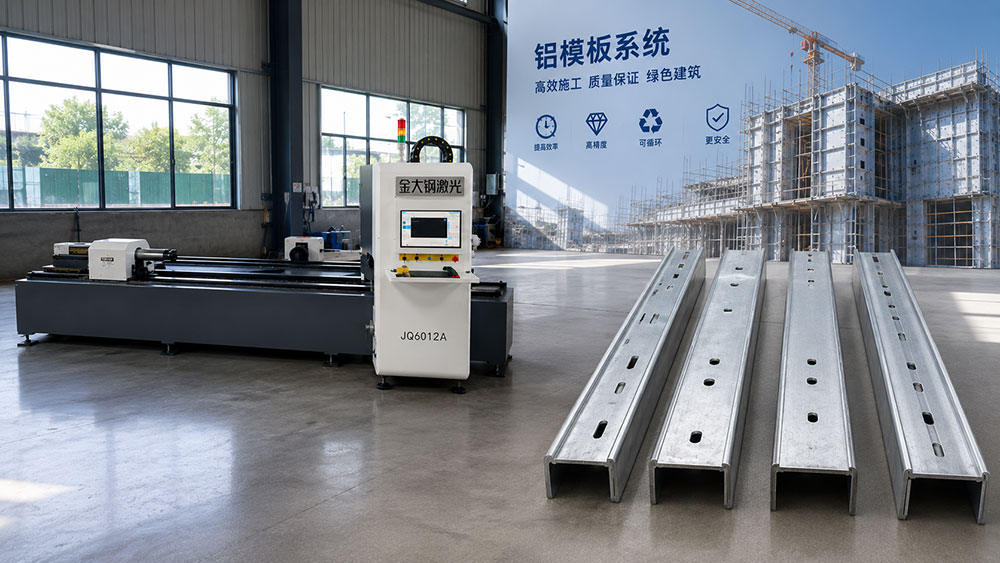
Following technical evaluation, we recommended a customized laser tube cutting machine solution adapted for processing formed U-shaped steel panels.
Our Recommended Solution
The solution centered around a high-efficiency laser cutting system equipped with a semi-automatic feeding arrangement.
Instead of manually positioning every workpiece, operators could arrange multiple U-panels on the loading rack, allowing continuous production with significantly reduced handling time.
The system was configured to process:
Cold-formed U-shaped panels
Structural steel profiles
Construction formwork components
Various custom-shaped metal sections
The production flow became:
Material Loading → Automatic Feeding → Precision Laser Cutting → Finished Product Output
This simplified workflow reduced production interruptions and improved overall manufacturing efficiency.
Key Benefits for Aluminum Formwork Manufacturing
Improved Production Efficiency
One of the biggest advantages was the reduction in manual handling.
With semi-automatic feeding support, operators could prepare multiple workpieces in advance, allowing the machine to run continuously.
This significantly increased daily output while reducing labor intensity.
Better Cutting Accuracy
Laser technology provides precise and repeatable cutting performance.
For aluminum formwork production, dimensional consistency is critical because every panel must fit correctly during assembly.
Improved accuracy helps reduce rework and ensures smoother installation at construction sites.
Reduced Material Waste
Traditional cutting methods often generate unnecessary scrap due to positioning errors and inconsistent cutting quality.
The laser system’s intelligent cutting functions optimize material usage and help reduce waste.
For manufacturers processing large volumes of material, even small reductions in waste can create substantial cost savings.
Lower Labor Costs
As labor costs continue rising in many manufacturing regions, automation becomes increasingly valuable.
The new production method reduced the number of manual operations required during cutting.
Workers could focus on production management and quality control instead of repetitive handling tasks.
Cleaner Finished Products
Laser cutting produces smooth and consistent cut surfaces.
This reduces the need for secondary finishing operations and helps improve overall product appearance and quality.
Flexible Production Capability
The system can process a wide range of profile types and dimensions.
This flexibility allows manufacturers to adapt more easily to changing project requirements and customer demands.
Supporting Faster Construction Projects
The construction industry increasingly relies on aluminum formwork systems because they provide:
Faster construction cycles
Improved concrete surface quality
Higher reusability
Reduced labor requirements on site
As demand grows, manufacturers must increase production capacity while maintaining strict quality standards.
Modern laser profile cutting solutions help manufacturers achieve these goals by combining automation, precision, and production flexibility.
For this Indonesian manufacturer, upgrading the cutting process represented an important step toward supporting larger construction projects and future business growth.
Building a More Competitive Manufacturing Operation
The decision to modernize production was not simply about replacing old equipment.
It was about creating a manufacturing process capable of meeting future market demands.
By adopting a customized laser cutting solution, the company improved:
Production efficiency
Cutting consistency
Material utilization
Labor productivity
Product quality
These improvements help create a more competitive operation in an increasingly demanding construction market.
A Practical Solution for Growing Manufacturers
Many aluminum formwork manufacturers face similar challenges as demand increases.
Traditional cutting methods often become bottlenecks that limit production growth.
Automated laser cutting technology offers a practical way to overcome these limitations while improving product quality and reducing operating costs.
For manufacturers seeking to expand production capacity without sacrificing quality, laser processing provides a scalable and future-ready solution.
Conclusion
This project demonstrates how an Indonesian aluminum formwork manufacturer improved production efficiency by upgrading from traditional cutting methods to a customized laser cutting solution.
By introducing automated feeding, precise laser cutting, and intelligent production capabilities, the company streamlined operations, reduced labor dependency, improved cutting accuracy, and enhanced overall manufacturing performance.
For aluminum formwork manufacturers looking to increase productivity, improve quality, and reduce production costs, laser tube cutting machines(这个关键词加入内链) provide an effective solution for long-term growth and competitiveness.