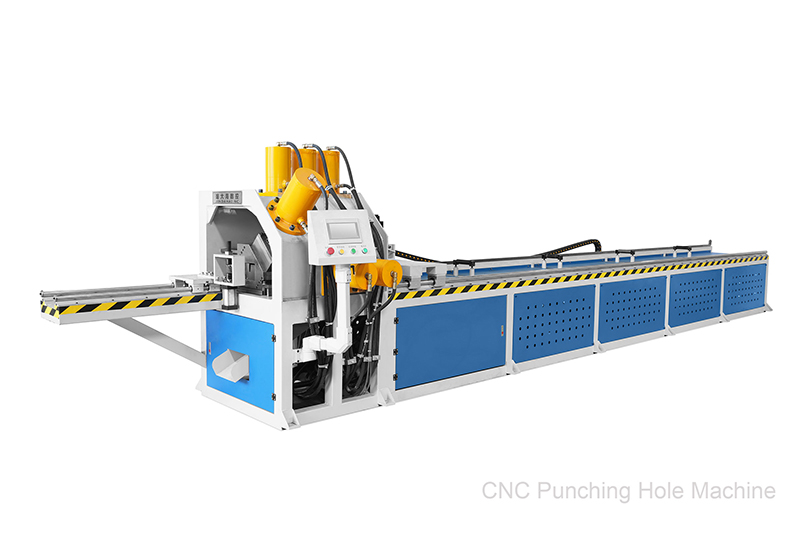
How a Dutch Wind Turbine Manufacturer Improved Structural Profile Processing
As renewable energy projects continue expanding across Europe, the wind energy sector faces increasing demand for high-quality structural components. Behind every wind turbine are numerous steel profiles used for support structures, equipment platforms, cable management systems, and auxiliary frameworks.
A manufacturer in the Netherlands specializing in wind turbine production relied heavily on channel steel and angle steel components throughout its manufacturing process. As project volumes increased, the company needed a faster and more precise way to process structural profiles while maintaining strict quality standards.
The challenge was not simply increasing output. The company also needed to improve consistency, reduce material waste, and shorten production lead times.
The Challenge: Traditional Saw Cutting Could No Longer Keep Up
For years, the manufacturer processed channel steel and angle steel using conventional sawing equipment.
While this approach was sufficient when production volumes were lower, several limitations became increasingly apparent as demand grew.
Operators needed to manually load materials, position profiles, measure cutting lengths, and repeatedly adjust equipment when switching between different profile sizes.
Each cutting cycle required significant operator involvement.
In addition, several quality issues frequently occurred during production:
Inconsistent cutting dimensions
Edge deformation on larger profiles
Uneven cutting surfaces
Additional grinding and finishing requirements
Material waste caused by setup adjustments
These problems increased production costs and reduced overall manufacturing efficiency.
For a company supplying components to the wind energy industry, maintaining dimensional accuracy and delivery schedules became increasingly difficult.
Why the Wind Energy Industry Requires Better Processing Methods
Wind turbine manufacturing differs from many traditional steel fabrication industries.
Projects typically involve large quantities of structural components that must fit precisely during assembly.
Any dimensional deviation can create installation difficulties and slow down production.
Furthermore, the rapid growth of renewable energy projects means manufacturers must continuously improve production efficiency to remain competitive.
The customer needed a solution capable of:
Processing multiple sizes of channel steel and angle steel
Improving cutting precision
Increasing production capacity
Reducing labor dependency
Lowering secondary processing requirements
Supporting future production expansion
After evaluating different processing technologies, the company began exploring laser tube cutting machine solutions.
Searching for a More Efficient Production Solution
Unlike traditional sawing equipment, laser cutting technology offers greater flexibility when processing structural steel profiles.
The customer wanted equipment capable of handling a wide range of profile sizes while maintaining stable cutting quality.
The machine also needed to support semi-automatic material feeding to reduce manual handling and improve productivity.
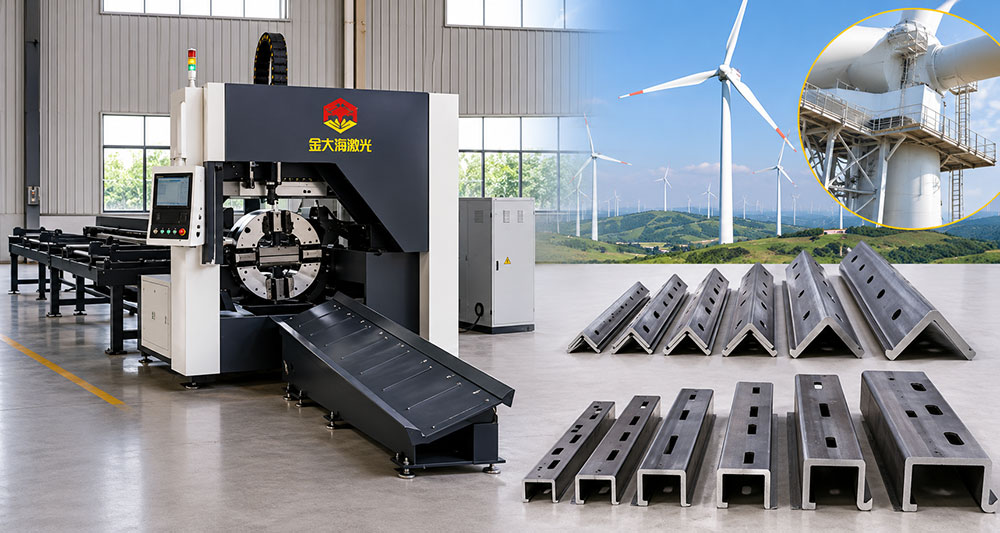
After reviewing the customer’s production requirements, we proposed a customized laser profile cutting machine solution specifically designed for structural profile processing.
Our Recommended Solution
The recommended system combined laser cutting technology with a semi-automatic feeding solution.
Instead of relying on repeated manual loading and positioning, operators could arrange materials on the feeding rack, allowing the machine to process profiles continuously.
The system was designed to handle:
Angle steel
Channel steel
Structural profiles
Various steel sections used in wind turbine production
The workflow became:
Material Loading → Automatic Feeding → Precision Cutting → Finished Product Output
This significantly reduced handling time and improved production consistency.
The machine was also configured to accommodate larger structural profiles commonly used in wind energy applications while maintaining high cutting precision.
Key Advantages for Wind Turbine Manufacturers
The benefits of laser processing extend beyond simply replacing traditional cutting methods.
For wind energy manufacturers, production efficiency and component quality directly impact project delivery schedules and overall profitability.
Improved Cutting Accuracy
Laser cutting produces clean and precise cuts with excellent dimensional consistency.
This helps ensure structural components fit correctly during assembly and reduces installation issues later in production.
Higher Production Efficiency
Automated feeding and continuous cutting significantly improve throughput compared with conventional saw cutting.
Manufacturers can process more materials within the same production period without increasing labor requirements.
Reduced Secondary Processing
Traditional saw cutting often requires additional grinding and surface finishing.
Laser-cut components typically require far less post-processing, helping reduce labor costs and shorten production cycles.
Lower Material Waste
Intelligent cutting software optimizes material utilization and helps minimize waste.
For manufacturers processing large quantities of steel profiles every month, improved material utilization can create substantial cost savings.
Greater Flexibility
A single machine can process multiple profile sizes without requiring dedicated tooling or lengthy setup procedures.
This is particularly valuable for manufacturers producing a variety of structural components.
Enhanced Workplace Safety
Automated material handling reduces direct operator interaction with cutting areas.
This creates a safer working environment and helps reduce the risk of production accidents.
Supporting Future Growth in Renewable Energy Manufacturing
The wind energy industry continues to expand rapidly worldwide.
Manufacturers must increase productivity while maintaining the strict quality standards required for critical infrastructure projects.
Modern structural steel laser cutting machine technology provides a practical solution for achieving these objectives.
Instead of relying on labor-intensive cutting methods, manufacturers can adopt automated production systems capable of supporting higher output levels with greater consistency.
For companies involved in wind turbine manufacturing, improving profile processing efficiency can have a direct impact on competitiveness and long-term growth.
A Smarter Approach to Structural Profile Processing
This project demonstrates how a Dutch wind turbine manufacturer modernized its production process by replacing traditional sawing operations with an automated laser cutting solution.
The new production workflow simplified material handling, improved cutting quality, reduced labor requirements, and increased manufacturing efficiency.
More importantly, the company established a scalable production platform capable of supporting future growth as demand for renewable energy infrastructure continues to increase.
Building a Competitive Advantage Through Automation
As competition intensifies throughout the renewable energy sector, manufacturers must continually improve production efficiency while controlling costs.
Automated profile cutting technology allows manufacturers to process more materials, reduce waste, improve consistency, and respond more effectively to market demand.
For this wind turbine manufacturer, upgrading profile processing capabilities represented more than a simple equipment replacement—it was an investment in long-term manufacturing competitiveness.
Conclusion
Faced with increasing demand and growing production challenges, this Dutch wind turbine manufacturer needed a more efficient solution for processing channel steel and angle steel components.
By implementing a customized laser cutting solution, the company improved cutting precision, reduced manual operations, increased production capacity, and minimized secondary processing requirements.
For manufacturers involved in renewable energy infrastructure, structural steel fabrication, and wind turbine production, laser cutting technology offers an effective path toward higher productivity, lower operating costs, and sustainable long-term growth.