Project Story: Upgrading Channel Steel Processing in Tajikistan
In the steel structure industry, precision and consistency are essential for producing reliable structural components. Channel steel is widely used in columns and base frames, where accurate hole positioning and identification marking play a critical role in assembly and installation.
In Tajikistan, a steel structure manufacturer faced increasing demand for high-volume production of channel steel columns and base frames. Each component required multiple hole types, marking, and cutting within strict tolerance standards.
This case study presents how the manufacturer improved its production process by adopting a CNC channel steel punching and marking solution, transforming a multi-step workflow into a more efficient integrated system.
Background: Channel Steel in Structural Applications
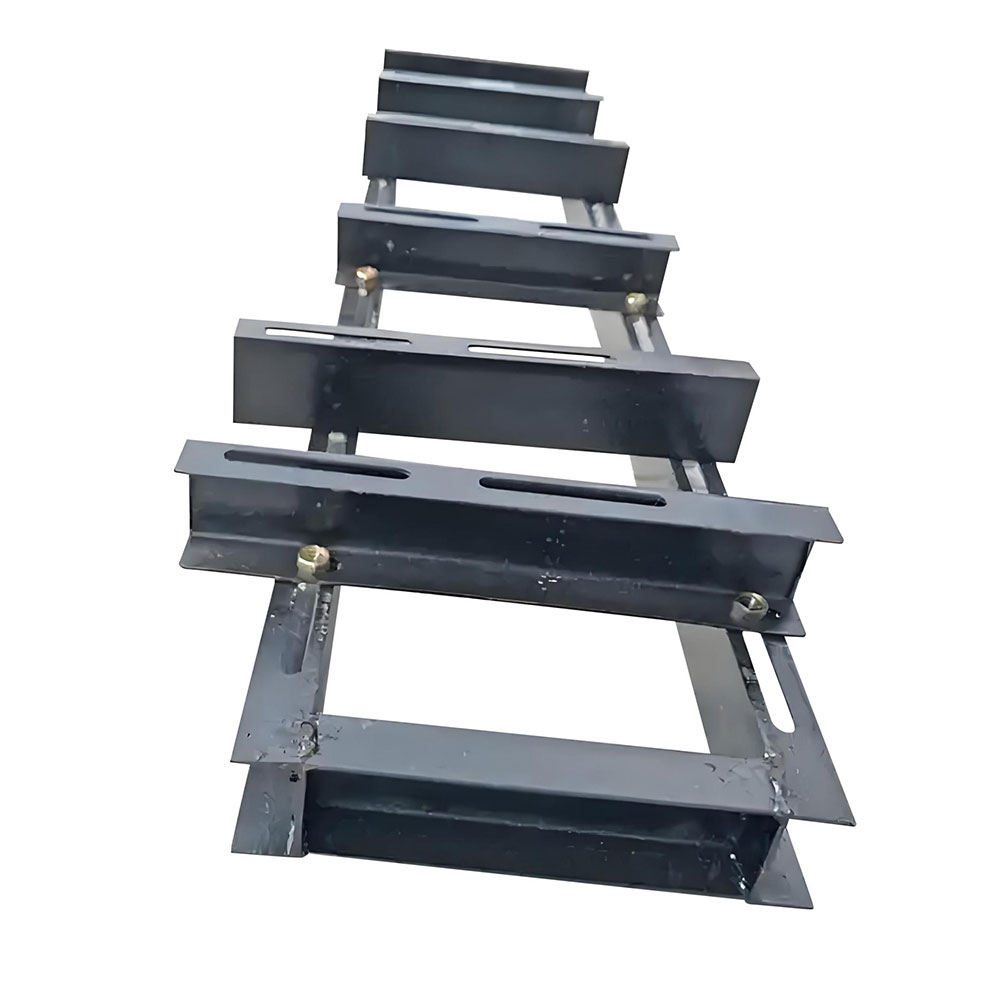
The customer produces structural components such as channel steel columns and frame bases used in construction projects.
These components require multiple processing steps, including:
Punching round and slot holes on different surfaces
Adding identification marks for product tracking
Cutting long materials into specified lengths
Because these parts are used in structural assemblies, both accuracy and repeatability are essential.
Challenges with Traditional Processing
Before upgrading their equipment, the manufacturer relied on conventional punching machines combined with manual marking and cutting.
As production volume increased, several issues became more significant.
Multiple operations required separate machines, increasing handling time.
Manual marking processes were inconsistent and slowed down production.
Frequent repositioning reduced accuracy across multiple surfaces.
Labor costs increased due to the need for multiple operators.
These limitations made it difficult to maintain production efficiency in a competitive market.
Defining the Requirements
To improve efficiency, the customer defined several key requirements.
The system needed to perform multi-side punching on channel steel.
Different hole sizes had to be processed within the same workflow.
Marking functionality was required to add identification codes to each product.
Cutting needed to be integrated to complete processing in one cycle.
The machine had to support continuous feeding for long materials.
The goal was to reduce manual intervention and improve production consistency.
The Proposed Solution: Integrated Punching, Marking, and Cutting System
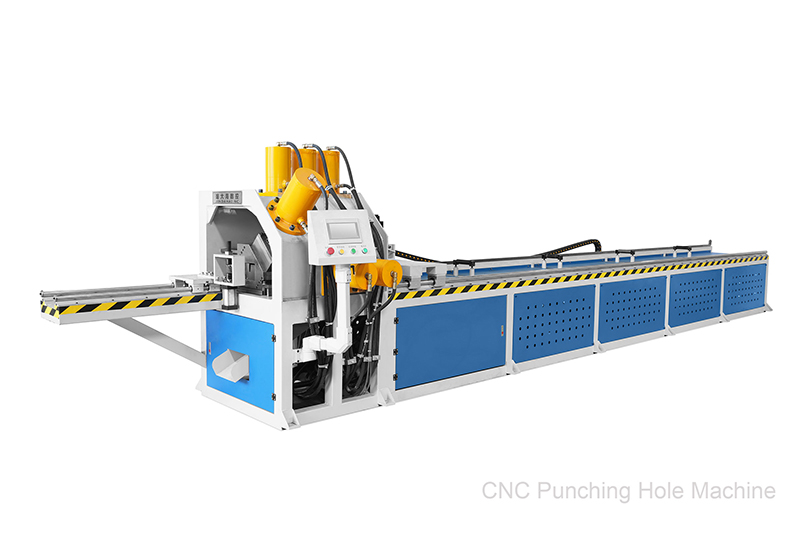
Based on these requirements, we provided a CNC structural steel punching and cutting solution with integrated marking capability.
The system combines punching, marking, and cutting functions into one machine, eliminating the need for multiple processing stages.
Instead of focusing on detailed specifications, the configuration emphasizes stability, efficiency, and reliable operation in industrial environments.
Key features include:
Multi-cylinder structure for simultaneous multi-side processing
Integrated marking system for product identification
Continuous feeding mechanism for long channel steel
CNC control system ensuring precise positioning
This allows the entire process—from raw material to finished component—to be completed in one workflow.
Streamlined Workflow with Integrated Marking
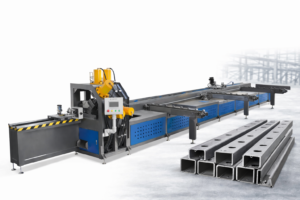
In daily production, channel steel is loaded onto the feeding system and positioned automatically.
The machine performs punching operations on different surfaces, followed by marking and cutting in sequence.
This integrated process eliminates the need for manual marking and reduces repositioning errors.
Multi-Function Processing in One System
One of the key advantages of this solution is the ability to complete multiple operations in a single setup.
Punching, marking, and cutting are all performed within one workflow.
This reduces production complexity and ensures consistent results across all products.
Improving Efficiency and Traceability
Compared with traditional methods, the new system offers several improvements.
Production efficiency increases due to fewer processing steps.
Marking ensures better traceability of components during installation.
Labor requirements decrease as operations become automated.
Hole positioning and cutting accuracy improve through CNC control.
Supporting Modern Steel Structure Manufacturing
For manufacturers producing structural steel components, efficiency and consistency are critical.
By adopting an integrated solution, the customer established a more stable and scalable production process.
The ability to combine punching, marking, and cutting in one system provides a significant advantage in high-volume production.
Conclusion
This project demonstrates how a steel structure manufacturer in Tajikistan improved its production workflow through equipment upgrading.
By implementing a CNC channel steel punching and marking solution, the company achieved higher efficiency, improved consistency, and better production control.
For manufacturers handling complex steel components, this approach offers a practical and scalable path toward modern production.