he bed frame industry has become increasingly competitive over the past few years. Manufacturers are expected to deliver stronger products, shorter lead times, and consistent quality while keeping production costs under control.
For one bed frame manufacturer in Canada, growing demand created a new challenge. Their factory specialized in producing bed frames, slatted bed bases, and furniture support structures made from square steel tubes. As production volume increased, their traditional drilling and tapping process gradually became a bottleneck.
To improve productivity and reduce labor dependence, the company began searching for a more efficient way to process square tubes used in furniture manufacturing.
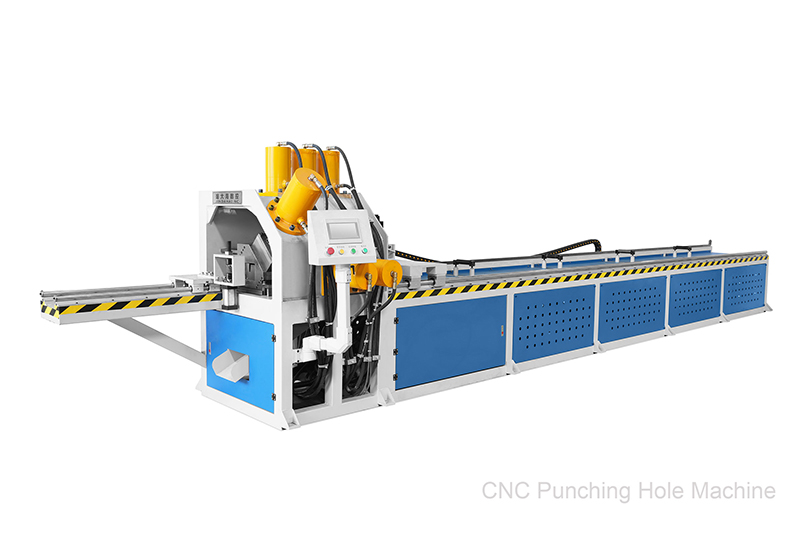
After evaluating several options, they decided to invest in a customized CNC hot drilling and tapping machine designed specifically for furniture tube processing.
The Challenge Behind Bed Frame Production
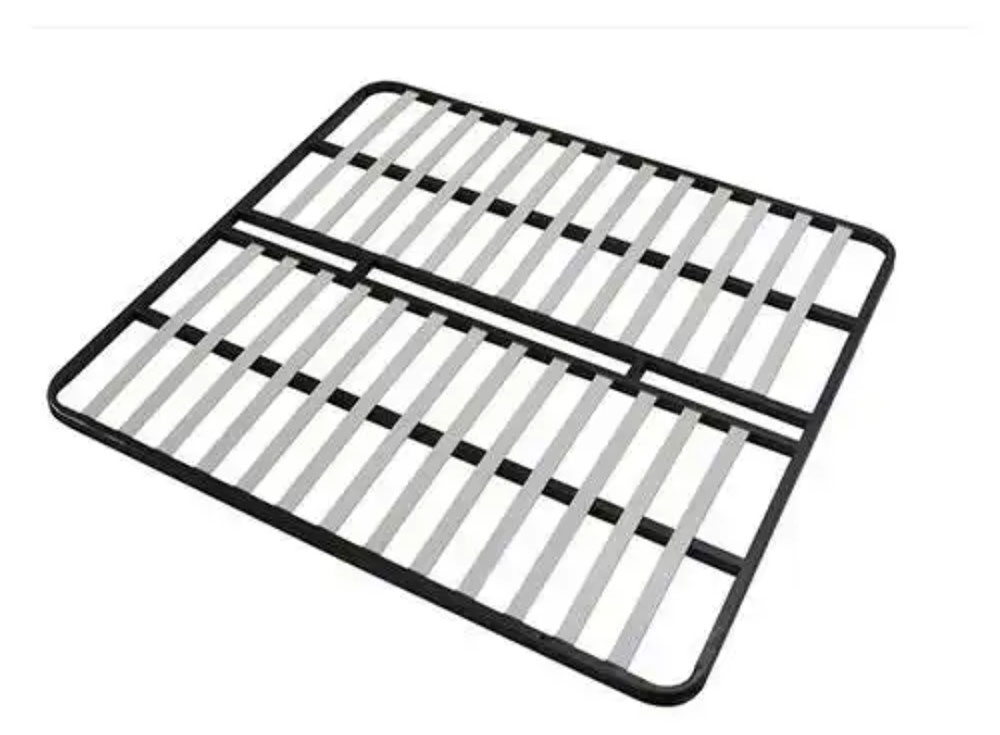
The customer mainly produced bed frame structures, slatted bed bases, and furniture support systems.
Their products required threaded holes on square tubes of various sizes. These threaded holes were essential for later assembly, allowing bolts and connectors to secure different frame components together.
Previously, the factory relied on conventional drilling and tapping equipment.
Although the process was functional, several problems became increasingly obvious as production volumes expanded.
Workers had to manually load and position each tube.
Drilling and tapping were completed as separate operations.
Production efficiency was limited by operator speed.
Maintaining consistent hole positions became difficult during large production runs.
Multiple operators were required across different processing stations.
For furniture manufacturers, these inefficiencies directly affect production capacity and delivery schedules.
The company needed a more automated solution capable of handling large production volumes while maintaining consistent quality.
Why Hot Drilling and Tapping Was the Better Choice
Traditional drilling removes material to create holes, which can limit thread strength on thin-wall tubes.
Hot drilling technology works differently.
By using friction-generated heat, material is displaced rather than removed. This creates a reinforced collar around the hole, providing more material for threading.
For bed frame production, this offers several advantages.
Stronger threaded connections.
Improved assembly reliability.
Reduced need for additional inserts or welding nuts.
Cleaner hole quality.
Better consistency during mass production.
These benefits made hot drilling particularly suitable for furniture and bed frame manufacturing.
Defining the Equipment Requirements
After reviewing the production process, the customer established several key requirements.
The machine needed to process square tubes up to approximately 4 meters in length.
Hot drilling and tapping had to be completed automatically in one production cycle.
The system needed to support multiple tube sizes, including 25 mm, 30 mm, and 40 mm square tubes.
Automatic feeding and positioning were required to reduce manual handling.
The customer also wanted a safer production environment with greater separation between operators and moving equipment.
Most importantly, the machine needed to support high-volume furniture production while maintaining consistent thread quality.
Our Proposed Solution
Based on these requirements, we developed a customized CNC tube drilling and tapping machine for bed frame manufacturing.
Instead of focusing on excessive technical complexity, the solution focused on reliability, automation, and production efficiency.
The system was designed with:
Dual-station processing capability
Integrated hot drilling and tapping functions
Automatic material feeding
Servo-controlled positioning
Heavy-duty machine structure
Industrial-grade tooling system
User-friendly control interface
This configuration allowed drilling and tapping operations to be completed within a single automated workflow.
How the Production Process Works
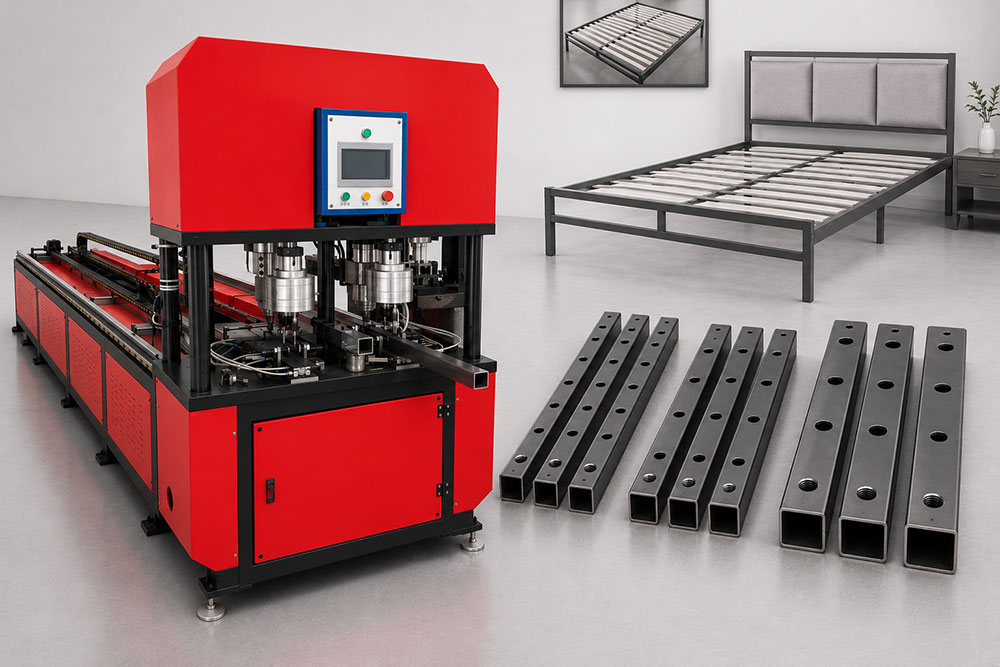
In daily production, operators place square tubes onto the loading rack.
The machine automatically feeds the material into the processing area according to the programmed dimensions.
The hot drilling process creates reinforced holes in the tube wall.
Immediately afterward, the tapping process creates internal threads ready for assembly.
Once processing is completed, finished components are automatically discharged for the next production stage.
The workflow can be summarized as:
Automatic Feeding → Hot Drilling → Tapping → Automatic Discharge
Because multiple operations are integrated into one system, unnecessary material handling and repositioning are eliminated.
This creates a smoother and more efficient production process.
Benefits for Bed Frame Manufacturers
For furniture manufacturers, production efficiency is often determined by how quickly structural components can be processed.
By implementing automated tube processing equipment, the customer gained several important operational advantages.
Reduced Labor Requirements
Traditional drilling and tapping often require multiple operators.
With automated processing, one operator can supervise multiple machines, significantly reducing labor costs.
Higher Production Throughput
Combining hot drilling and tapping into one workflow eliminates unnecessary handling between stations.
This allows more parts to be processed within the same production shift.
Better Product Consistency
Automatic positioning improves dimensional accuracy and thread consistency.
This helps ensure smooth assembly during later production stages.
Stronger Threaded Connections
Hot drilling creates additional material around the hole, resulting in stronger threads compared to conventional drilling.
This is particularly important for furniture products subjected to repeated loading and use.
Improved Workplace Safety
Manual interaction with rotating tools is reduced significantly.
The automated system allows operators to remain separated from the main processing area during operation.
Lower Production Costs
Reduced labor requirements, fewer secondary operations, and higher production efficiency all contribute to lower manufacturing costs over time.
Supporting Future Growth
The furniture industry is constantly evolving, with manufacturers facing increasing demands for faster delivery and better product quality.
By upgrading to CNC automation, the customer created a production platform capable of supporting future growth without dramatically increasing labor requirements.
The machine can accommodate different tube sizes and future product variations, allowing the manufacturer to respond more quickly to changing market demands.
This flexibility is especially valuable for companies producing multiple bed frame models and furniture components.
Conclusion
This project demonstrates how a Canadian bed frame manufacturer improved production efficiency through a customized CNC hot drilling and tapping solution.
By replacing traditional drilling methods with an automated production system, the company streamlined its workflow, reduced labor requirements, improved thread quality, and increased manufacturing consistency.
For manufacturers producing bed frames, slatted bed bases, and furniture support structures, CNC hot drilling and tapping technology provides a practical way to increase productivity, reduce operating costs, and maintain stable product quality in a competitive market.