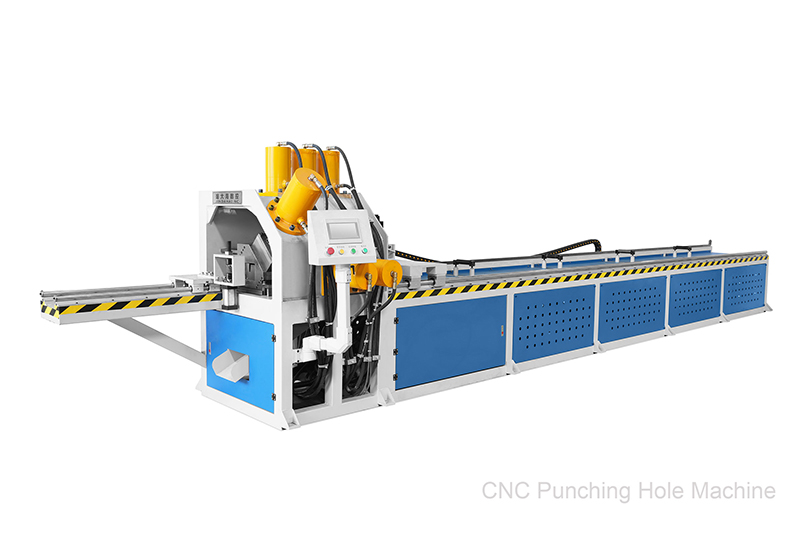
Tube processing has become one of the most important stages in modern metal fabrication. Many finished products may look simple on the outside, but the tube parts inside them often require accurate length cutting, precise hole positioning, clean end shaping, and repeatable geometry before they are ready for welding or assembly. When these steps are handled poorly, the problem does not stay at the cutting station. It spreads into the next stage of production, creating delays, rework, wasted material, and unstable product quality.
This is why the laser tube cutting machine has attracted so much attention across manufacturing industries. It gives factories a more efficient way to process tubes and profiles with digital control instead of relying heavily on repeated manual setup. For manufacturers under pressure to improve delivery time, cut labor waste, and maintain consistent quality, tube laser cutting is no longer just an advanced option. In many workshops, it is becoming a practical necessity.
The market interest around this equipment is also linked to broader changes in customer demand. Buyers today expect more customization, cleaner appearance, tighter tolerances, and shorter lead times. At the same time, factories face rising labor costs and more competition. Traditional methods can still complete the work, but they often become slow and difficult to manage once orders involve several tube sizes, multiple hole patterns, special end cuts, or frequent drawing changes. A digital cutting process fits that environment better because it improves repeatability while remaining flexible.
Another reason laser tube cutting matters is that metal tubes are used in so many products. They appear in furniture frames, storage systems, construction supports, gym equipment, machine structures, railings, transport parts, and display racks. Some of these products are mainly structural, while others are both structural and visible to the customer. In both cases, cutting quality has a direct effect on downstream assembly and on the overall impression of the finished product.
This guide explains laser tube cutting from a practical manufacturing perspective. It covers what the machine does, what materials and profile types it can handle, where the market uses it, how factories run it in everyday production, and what advantages it brings to industrial work. The goal is not only to define the technology, but to help readers understand why it has become such an important part of modern fabrication strategy.
Why Tube Processing Is Harder Than It Looks
At first glance, a tube does not appear to be a difficult part to process. It has a regular shape, a clear outside profile, and a simple basic structure. But once that tube becomes part of a real product, the processing requirements can become surprisingly complex. One part may need several holes placed along a fixed axis, an angled end to fit another component, and a slot or contour cut that must match a specific assembly point. If one of those features drifts out of position, downstream work becomes slower and more difficult.
Traditional processing methods usually treat these requirements as separate tasks. A saw may cut the material to length. A drill may create holes. Another machine may form slots or special ends. Then the part may be checked again by hand before moving to welding or finishing. This approach can work, especially for simple jobs or small quantities, but it also creates repeated handling and repeated opportunities for human error. Every new station introduces another setup, another reference point, and another chance for slight variation.
These challenges become even bigger when a factory handles mixed production. Many manufacturers no longer run only one standard part for long periods. They move between different customer specifications, different tube sizes, and different product categories. In such an environment, a workflow that depends too heavily on manual measurement and repeated repositioning becomes difficult to scale. The factory can still finish the order, but it often pays for that flexibility through slower throughput and higher labor use.
Laser tube cutting changes this logic. Instead of building the part step by step on separate machines, the geometry is defined first in a digital program. The machine then creates the required features as one coordinated process. This reduces process fragmentation and helps maintain consistency from the beginning. The value is not only speed. The value is control.
What a Laser Tube Cutting Machine Does
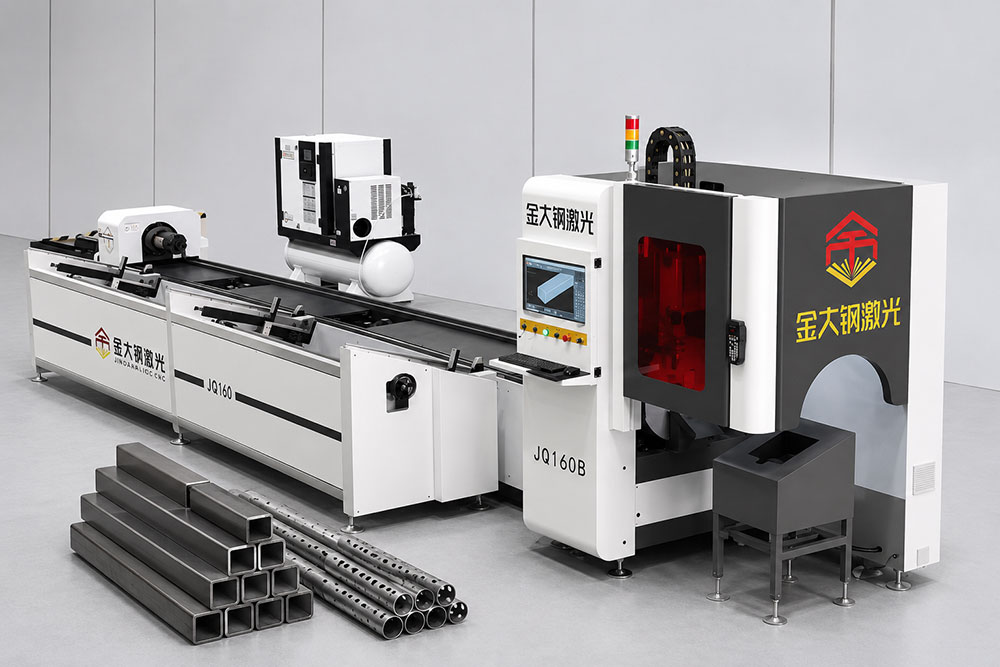
A laser tube cutting machine is a CNC-controlled system designed to cut tubes and profiles with a focused laser beam according to a programmed path. In practical production terms, that means it can do much more than cut straight lengths. It can also produce holes, slots, contours, end cuts, bevels, notches, and other connection features directly on the material.
This is one reason the machine is so useful in fabrication. Real tube parts are rarely just plain lengths. They usually need geometry that connects with other parts, whether for welding, assembly, fitting, or appearance. A machine that can create these features within one system reduces the need to transfer the work between several disconnected stations. That makes production easier to organize and easier to standardize.
The process is software-driven. Operators or engineers define the material type, wall thickness, tube dimensions, and feature geometry before cutting begins. Once that program is prepared, the machine follows it with coordinated motion and repeatable control. Because the logic is digital, part-to-part consistency is much easier to maintain. This is one reason why a fiber laser tube cutting machine is often associated with better stability in modern manufacturing.
Another important point is flexibility. In traditional workflows, changing a part may require different fixtures, new measuring steps, or repeated trial-and-error adjustment. In a digital laser process, many of those changes can be made inside the program. That makes the machine suitable not only for repeat orders, but also for customized jobs and frequent design revisions.
It is also important to understand that the machine does not only improve the cutting stage. By producing more stable parts from the start, it helps improve what happens later in welding, fitting, grinding, and assembly. That broader effect is one of the main reasons factories invest in this technology.
Materials and Profile Types Commonly Processed
One of the biggest strengths of laser tube cutting is that it works across a wide range of real production needs. Most fabrication businesses do not process just one material and one shape forever. They usually deal with several industries, several customers, and several product families. A cutting system that supports this variety creates much stronger long-term value than one limited to a narrow niche.
In many workshops, the most common materials are carbon steel, stainless steel, and aluminum. Carbon steel is widely used in structural supports, racks, frames, and machine components. Stainless steel is often selected for cleaner appearance, corrosion resistance, or hygienic environments. Aluminum is useful where reduced weight matters. A machine that can cover these main material categories helps a manufacturer serve more markets without dividing work across too many specialized systems.
In terms of shape, round tubes and square tubes are the most common, but they are not the only ones. Many jobs also involve rectangular tubes, oval tubes, and certain profiles depending on machine design. Some factories work mainly with round tube for gym equipment or rail products. Others focus on square and rectangular tube for storage systems, welded structures, and cabinet frames. Many real factories handle both at the same time.
That is why phrases such as round tube cutting applications and square tube fabrication cases are meaningful in both production and content strategy. Buyers usually search based on the kind of products or profiles they already make. When the machine clearly matches their actual material and shape requirements, the benefit is easier to understand.
A wider usable range also gives the workshop more flexibility when business changes. Instead of relying on different equipment logic for every product family, the factory can process more of its work through one central system. That makes planning easier and helps support future growth.
Where the Market Uses Laser Tube Cutting
Laser tube cutting has spread across many sectors because metal tubes are used in so many structural and fabricated products. What changes from industry to industry is not the need for tube processing itself, but the type of geometry, volume, and finish required.
Construction and project fabrication are major application areas. Tubes and profiles are widely used in support frames, guardrails, walkways, barriers, canopy structures, and fabricated building components. In these projects, dimensional accuracy is important because it affects welding efficiency and on-site installation. This is why the technology has become increasingly useful in architectural steel fabrication and similar structural applications.
Furniture is another strong market. Metal shelving, bed frames, tables, chairs, cabinets, office systems, and decorative frames all depend on accurate tube parts. In furniture, appearance is often just as important as strength. Rough cuts, unstable fit-up, or poor consistency become highly visible once the product is coated or assembled. That is why laser cutting is especially valuable in furniture frame manufacturing and other consumer-facing applications.
Fitness equipment is also a very clear use case. Exercise machines often require round or shaped tubes with repeated holes, connection slots, and visible welded joints. A process that supports repeatable geometry and clean cuts makes these products much easier to fabricate consistently. Other important sectors include warehouse storage systems, transport components, industrial racks, agricultural equipment, machine frames, and custom fabricated assemblies.
The key point is that laser tube cutting is not tied to one single product category. It serves many markets because they all share the same need: efficient, accurate, and flexible processing of metal tubes and profiles.
How the Cutting Process Works
The tube laser cutting process begins with digital preparation. A program is created based on the part design, including tube dimensions, wall thickness, material type, and required geometry. Once this information is ready, the raw tube is loaded into the machine and secured in place by a clamping system.
The clamping mechanism holds the tube steady while also allowing controlled rotation when necessary. The cutting head then moves according to the programmed path. The laser beam is focused into a very small point on the material surface. At that point, the energy becomes intense enough to melt or vaporize the metal. Assist gas removes the molten material and helps create a cleaner cut edge.
What makes the process powerful is coordination. Tube rotation, head movement, speed, feature order, and position control all work together. This is what allows the machine to create multiple features on one part with good repeatability. The process is not simply a beam cutting a tube. It is a complete digitally controlled manufacturing sequence.
Because the system is software-based, programs can be saved and reused. That means repeat production becomes easier to restart, and revised orders can often be adjusted more quickly than in a fixture-heavy workflow. For many factories, this balance between repeatability and flexibility is one of the strongest practical reasons to adopt the technology.
How the Machine Works on the Shop Floor
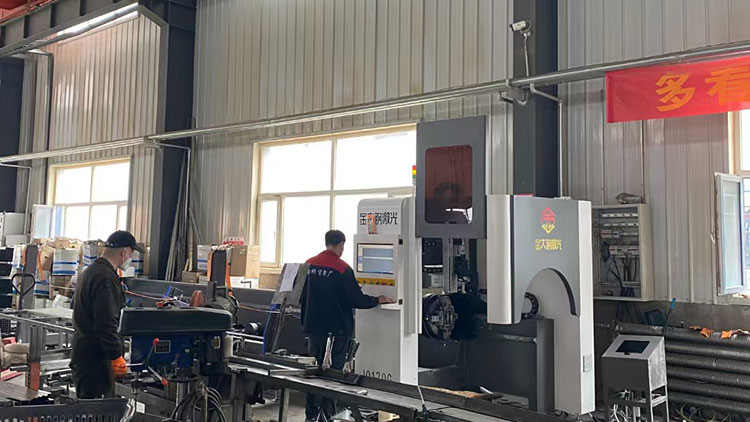
In daily factory work, the laser tube cutting machine is part of a wider production chain rather than a stand-alone device. The job often starts with engineering preparation. Drawings are checked, geometry is confirmed, and processing parameters are selected. This stage matters because good cutting performance depends on how well the program reflects the real part requirements.
Once the setup is ready, material is brought to the machine. Some factories still rely on manual loading, especially when quantities are moderate or the tube range changes often. Others improve continuity with automated loading, which helps reduce repeated manual handling and supports steadier throughput. In higher-output environments, loading automation can make a major difference.
During cutting, the operator’s job changes compared with traditional tube processing. Instead of measuring every hole and moving every part by hand from one machine to another, the operator supervises the system, checks gas flow, monitors part quality, and keeps production stable. This changes the workshop labor model from repeated manual positioning toward controlled process management.
After cutting, the part moves to downstream operations such as welding, fitting, bending, finishing, coating, or final assembly. This is where many of the machine’s less obvious advantages appear. If geometry is cleaner and more repeatable, downstream work becomes easier. Weld fit-up improves, adjustment time decreases, and the workshop flows more smoothly overall.
Benefits for Industrial Production
The first major benefit of tube laser cutting is process integration. Traditional workflows often split cutting, drilling, slotting, and shaping into separate operations. Each operation takes time and creates another chance for dimensional variation. By creating more geometry in one coordinated process, laser cutting makes the workflow simpler and easier to manage.
A second benefit is repeatability. Factories value repeatability because it improves everything that comes later. Stable hole positions, cut angles, and end profiles reduce welding problems and make assembly easier. This helps prevent the small inconsistencies that can quietly consume labor across a production line.
Another benefit is labor efficiency. A digital cutting process allows one operator to supervise more of the work than would be possible in a manual multi-station setup. Skill is still required, but it is used differently. More of the effort goes into programming, monitoring, and quality management, while less goes into repeated measuring and repositioning.
Quality improvement is also important. Cleaner cuts, better dimensional control, and more stable geometry reduce deburring, grinding, and rework. In visible products, this supports a better final appearance. In structural products, it helps improve assembly reliability. In both cases, the benefit extends beyond the cutting station.
Finally, the technology improves responsiveness. Modern manufacturing often involves mixed batches, revised dimensions, and customer-specific requests. A fixture-heavy process handles these changes slowly. Tube laser cutting adapts better because much of the change happens in software instead of through rebuilding the workflow physically.
Why Precision Matters So Much
Precision matters because tube parts are usually part of something larger. They connect to frames, supports, fittings, brackets, or visible structures. A small deviation in length, hole position, or cut angle may seem minor on its own, but it becomes more expensive once the part enters welding or assembly. This is why precision tube cutting has such a broad impact on production quality.
Precision affects fit-up speed, assembly alignment, final appearance, and the reliability of larger product structures. In products such as furniture and fitness equipment, it also affects visual quality. In structural or industrial products, it affects how smoothly large batches can move through the workshop.
It also affects scalability. A few manual corrections may be manageable in small quantity, but the same approach becomes costly and unstable when production grows. Better precision from the beginning reduces the need for late-stage correction and helps create a more scalable process.
What Buyers Should Evaluate
One of the most common buyer mistakes is focusing too much on laser power alone. Power is important, but it is not the whole story. Motion stability, clamping quality, software usability, maintenance convenience, and supplier support all influence how well the machine performs in daily production.
Buyers should also think carefully about their real products and production conditions. The best machine is not automatically the largest or most expensive one. It is the one that matches the tube sizes, materials, geometry complexity, and order patterns of the actual workshop.
Ease of use matters too. Even strong hardware becomes frustrating if the software is difficult to manage or the after-sales support is poor. Long-term value depends on the full ownership experience, including training, spare parts, and technical response.
Conclusion
Laser tube cutting has become increasingly important because modern fabrication demands more than simple cutting speed. Manufacturers need better repeatability, smoother workflow, easier changeovers, and stronger downstream consistency. As tube-based parts remain essential across construction, furniture, storage systems, machine structures, and many other markets, the need for a better tube-processing method continues to grow.
A laser tube cutting machine helps manufacturers move from a fragmented, labor-heavy process toward a more integrated digital workflow. It improves geometry control, reduces repeated handling, supports better part consistency, and makes downstream assembly easier. These are practical advantages that affect everyday factory performance.
For manufacturers that want stronger capability, more stable output, and a more competitive fabrication process, tube laser cutting is no longer just a high-end option. It is increasingly becoming a core production tool.