Metal hole processing is a basic but very important part of industrial manufacturing. Many products require holes, slots, notches, or repeated patterns before they can be assembled, welded, bolted, installed, or used in final structures. These products may include steel profiles, aluminum profiles, angle iron, channel steel, square tubes, round tubes, flat bars, guardrails, shelves, scaffolding parts, solar brackets, machinery frames, and construction components.
In the past, many factories relied on manual drilling, hand-operated punching, simple hydraulic presses, or several separate machines to complete these tasks. These methods can still work for small jobs, but they often become slow and inconsistent when the production volume increases. Workers need to measure, mark, position, drill, punch, and inspect the parts repeatedly. This takes time, requires skill, and can easily lead to errors.
This is why the CNC punching machine has become an important solution for modern metal fabrication. It uses computer numerical control to process holes and shapes according to a programmed drawing or parameter setting. Instead of depending mainly on manual measurement, the machine controls feeding, positioning, punching, and sometimes cutting automatically. This makes metal hole processing faster, more accurate, and easier to repeat.
A CNC punching machine is not only a machine for making holes. In many factories, it is a production efficiency tool. It can help reduce labor intensity, improve consistency, save time, and make batch production easier to manage. For manufacturers that process metal profiles every day, this equipment can directly affect production speed, product quality, and delivery capability.
What Is a CNC Punching Machine?
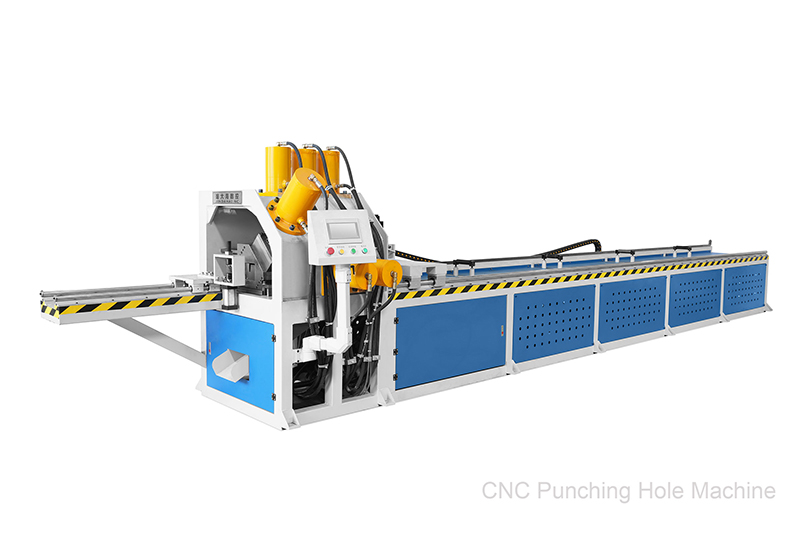
A CNC punching machine is a metal processing machine that uses a punch and die to create holes, slots, or other shapes in metal materials. The machine is controlled by a CNC system, which means the feeding position, punching distance, hole pattern, and working sequence can be set and repeated automatically.
The basic punching principle is simple. The punch moves down with strong pressure and pushes the metal material into the die. This creates a hole or shape according to the punch and die design. Compared with drilling, punching is usually faster for repeated holes because the machine does not need to slowly remove material with a rotating drill bit. Instead, it forms the hole through pressure in one stroke.
A metal punching machine can be designed for different materials and profiles. Some machines are used for sheet metal. Some are used for tubes. Some are made for angle iron, channel steel, flat bars, aluminum profiles, guardrails, or special-shaped materials. The machine structure depends on the product type, material thickness, hole size, and production requirement.
For industrial production, CNC control is the key advantage. Once the operator enters the hole distance, quantity, material length, and processing pattern, the machine can complete repeated punching with stable positioning. This reduces manual measuring and helps the factory produce parts with better consistency.
Where CNC Punching Machines Are Used
CNC punching machines are widely used in industries where metal parts need repeated holes or accurate hole positions. One common application is construction metal fabrication. Steel structures, scaffolding systems, climbing frames, guardrails, handrails, support brackets, and building accessories often need many holes for bolts and installation. A CNC punching machine can process these holes quickly and accurately.
Another major application is solar mounting systems. Solar brackets and support profiles usually require regular hole patterns for installation and adjustment. Because these products are often produced in large quantities, manual drilling can be too slow. CNC punching helps manufacturers improve output while keeping hole spacing consistent.
In the furniture industry, metal tubes and profiles are used for shelves, storage racks, bed frames, tables, chairs, display stands, and office furniture. Accurate punching helps parts fit together during assembly. It can also reduce the need for manual correction.
In machinery manufacturing, metal frames, brackets, covers, and support structures often require holes for bolts, shafts, cables, or accessories. A CNC hole punching machine helps improve accuracy and reduces the risk of assembly problems.
Fitness equipment manufacturers also use punching machines for round tubes, square tubes, and special profiles. The holes must often align with adjustment pins, bolts, and moving parts. If the hole position is inaccurate, the equipment may not assemble correctly or may not work smoothly.
Other common industries include agricultural machinery, warehouse racks, logistics equipment, metal doors and windows, highway guardrails, electrical cabinets, elevator parts, trailer manufacturing, and customized metal processing workshops. In all these industries, hole accuracy and production efficiency are important.
What Materials and Profiles Can Be Processed?
The material range of a CNC punching machine depends on the machine model, punch force, mold design, and feeding structure. Common materials include carbon steel, stainless steel, aluminum, galvanized steel, copper, and some other metal materials. Carbon steel and galvanized steel are especially common in construction, machinery, racks, and guardrail production.
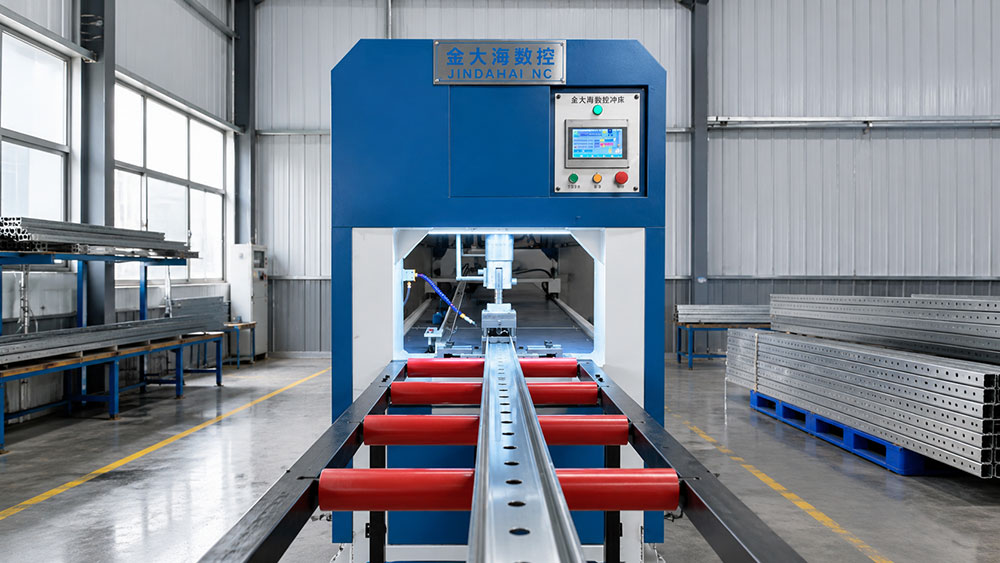
Many CNC punching machines are designed for metal profiles instead of only flat sheets. These profiles may include angle iron, channel steel, square tubes, rectangular tubes, round tubes, flat bars, U-channel, C-channel, aluminum profiles, and customized special-shaped materials.
For example, an angle iron punching machine is mainly used to punch holes on angle steel. This type of machine is common in tower manufacturing, steel structure production, shelves, brackets, and construction accessories. Since angle steel has two sides, the machine design must support stable positioning and accurate hole processing.
A tube punching machine is used for round tubes, square tubes, or rectangular tubes. It may process holes on one side, two sides, or multiple sides depending on the product design. Some machines can also combine punching and cutting, allowing the factory to complete more operations in one process.
For aluminum profiles, the machine may need customized molds and support systems because aluminum profiles often have special shapes and internal structures. A suitable machine can help manufacturers punch square holes, round holes, slots, or installation holes accurately.
Before choosing a machine, buyers should confirm material type, profile shape, thickness, hole size, hole distance, production volume, and whether cutting is also required. These details directly affect the machine design and configuration.
How a CNC Punching Machine Works
The working process usually starts with material preparation. The operator prepares the metal profile according to the required length and specification. Then the material is placed on the feeding system or machine table. For some machines, the operator manually loads the material. For more automated systems, automatic feeding or loading devices may be used.
Next, the operator enters the processing data into the CNC system. This may include material length, hole quantity, hole spacing, first hole distance, punching position, and production quantity. Some machines support drawing import, while others use parameter input. The exact method depends on the machine control system.
After the program is set, the machine clamps or positions the material. The feeding system moves the material forward according to the programmed distance. When the material reaches the correct position, the punching cylinder or press mechanism drives the punch down and creates the hole. The machine then continues feeding and punching until the programmed process is completed.
If the machine includes cutting function, it can also cut the material after punching. This is useful for products that need fixed lengths and repeated hole patterns. The combination of punching and cutting can reduce manual handling and improve production efficiency.
During operation, the operator needs to check material positioning, mold condition, hydraulic pressure, lubrication, feeding accuracy, and finished hole quality. Although the machine is controlled by CNC, proper setup and maintenance are still important for stable production.
What Problems Does CNC Punching Solve?
One of the biggest problems solved by CNC punching is repeated manual measurement. In traditional processing, workers may need to mark every hole position before drilling or punching. This takes time and can easily create errors. If one hole is misplaced, the whole part may become unusable or require rework.
With CNC punching, the machine controls the hole distance automatically. Once the program is correct, the same pattern can be repeated many times. This is very helpful for batch production.
Another problem is low production speed. Drilling holes one by one can be slow, especially when the material is thick or the number of holes is large. Punching can complete many holes much faster because each hole is formed in a single stroke. For products with repeated holes, the time saving can be significant.
Labor dependence is also reduced. Manual drilling and measuring require experienced workers. If the operator is inexperienced, tired, or working under pressure, mistakes may happen. CNC punching reduces the need for constant manual positioning, making production easier to standardize.
CNC punching can also reduce secondary correction. When hole positions are accurate, parts are easier to assemble. Workers spend less time enlarging holes, adjusting positions, or correcting mistakes. This improves the whole production flow, not just the punching step.
For factories that process a large number of metal profiles, these improvements can help reduce cost, increase output, and improve delivery reliability.
Convenience for Industrial Production
A CNC punching machine brings several practical conveniences to industrial production. The first is faster batch processing. Once the program is set, the machine can process many pieces with the same hole pattern. This is especially useful for products such as guardrails, scaffolding parts, solar brackets, racks, and metal frames.
The second convenience is easier operation. Compared with fully manual processing, CNC punching makes the production process more predictable. Operators do not need to measure every hole manually. They mainly need to set the program, load the material, monitor the process, and check quality.
The third convenience is better consistency. In industrial production, consistency is often more important than making one perfect sample. Every part in a batch must match the same standard. A hydraulic punching machine with CNC feeding can help keep hole spacing and punching quality stable.
The fourth convenience is flexible production. Many factories receive different orders with different hole positions, material lengths, and profile sizes. CNC systems allow operators to change parameters more easily. This helps manufacturers respond to customized orders without relying too much on fixed manual methods.
The fifth convenience is lower physical labor. Metal profiles can be heavy and difficult to handle. Repeated manual drilling or punching can be tiring and unsafe. A CNC punching system reduces repetitive manual work and helps create a more efficient workshop.
Benefits for Assembly and Installation
Hole processing quality directly affects assembly and installation. If the holes are inaccurate, workers may have difficulty connecting parts with bolts, screws, pins, or brackets. This can slow down assembly and create quality problems.
For example, in scaffolding or climbing frame production, hole accuracy is important for safety and installation speed. If hole positions are inconsistent, the parts may not connect correctly on site. This can cause delays and increase labor cost.
In solar bracket production, holes need to match installation requirements. Accurate hole spacing helps installers assemble the system quickly and correctly. Poor hole accuracy may lead to adjustment problems during installation.
In furniture and rack manufacturing, accurate holes help parts align better. This improves the appearance and stability of the finished product. For products that need repeated assembly, such as shelves or storage systems, hole consistency is especially important.
A profile punching machine can improve the connection quality of metal profiles by keeping holes in the correct position. This reduces rework and helps the final product look more professional.
CNC Punching vs. Traditional Drilling
Many factories compare CNC punching with traditional drilling before choosing equipment. Both methods can create holes, but they are suitable for different production needs.
Drilling uses a rotating drill bit to remove material gradually. It is flexible and suitable for small quantities, special holes, or situations where punching is not practical. However, drilling can be slower for repeated holes, especially on thicker materials or large batches. Drill bits also wear out and need replacement.
Punching uses pressure to form a hole quickly. For repeated holes and batch production, punching is usually much faster. The hole is completed in one stroke, and the machine can continue feeding to the next position. This makes punching very suitable for industrial profile processing.
However, punching requires suitable molds. Different hole sizes and shapes may need different punches and dies. If the product changes frequently and every order needs a unique hole shape, mold planning is important.
In many factories, drilling and punching are not complete replacements for each other. Instead, they serve different purposes. CNC punching is especially valuable when the factory needs high-speed, repeated, accurate holes on metal profiles.
Semi-Automatic and Automatic Punching Systems
CNC punching machines can be designed with different automation levels. A semi-automatic system may require manual loading and unloading, while the feeding and punching process is controlled by the machine. This type is suitable for small and medium factories that want to improve efficiency without investing in a very complex production line.
An automatic punching machine may include automatic feeding, automatic positioning, automatic punching, automatic cutting, and sometimes automatic unloading. It is suitable for factories with higher production volume and more repetitive products. Although the initial cost may be higher, it can reduce labor and improve output.
The choice depends on production needs. A small workshop may not need a fully automatic system if daily output is limited. A large manufacturer, however, may need automation to keep up with orders and reduce labor pressure.
Buyers should consider material length, profile weight, daily production quantity, product variety, workshop space, labor cost, and budget. The best machine is not always the most advanced one. It should match the actual production situation.
How to Choose the Right CNC Punching Machine
Before buying a CNC punching machine, the first thing to confirm is the material and profile type. A machine for flat bars may not be suitable for square tubes. A machine for angle iron may need a different structure from a machine for aluminum profiles. The material shape determines the feeding method, clamping system, mold design, and punching position.
The second factor is material thickness. Thicker materials need stronger punching force and more durable molds. If the machine force is not enough, the punching quality may be poor, or the machine may wear quickly.
The third factor is hole size and shape. Round holes, square holes, slots, and special holes may require different molds. Buyers should provide drawings or samples before selecting the machine.
The fourth factor is production quantity. For small batches, a simple CNC machine may be enough. For large batches, automatic feeding and cutting can bring more value.
The fifth factor is accuracy requirement. Some products need general installation holes, while others require stricter tolerance. The machine structure, feeding system, and control accuracy should match the product requirement.
The sixth factor is after-sales support. A CNC punching machine includes mechanical structure, hydraulic system, electrical system, control software, molds, and feeding devices. Good technical support can help the customer solve problems quickly and keep production stable.
For buyers comparing different metal punching solution options, it is better to evaluate the complete production process instead of only comparing the machine price.
Maintenance and Daily Operation
Regular maintenance is important for stable punching quality. Operators should check the mold condition, hydraulic oil level, lubrication, bolts, feeding system, electrical cabinet, sensors, and safety devices. If the mold becomes worn, the hole edge may become poor, and the machine may require more force to punch.
The punch and die should be matched correctly. If the clearance between punch and die is not suitable, the hole quality may be affected. Poor clearance may also shorten mold life.
The feeding system should be kept clean and accurate. Dust, metal chips, or poor alignment may affect positioning. Operators should also check whether the material is straight. Bent or twisted profiles may affect feeding accuracy and hole position.
Hydraulic systems should be inspected regularly. Stable hydraulic pressure is important for punching force. Oil leakage, dirty oil, or poor pressure control may affect machine performance.
Operators should also follow safety rules. Hands should not be placed near the punching area during operation. Safety guards and emergency stops should be checked regularly. Only trained workers should operate the machine.
Good maintenance helps reduce downtime, extend machine life, and keep production quality stable.
Value for Small and Medium Manufacturers
CNC punching machines are not only useful for large factories. Small and medium manufacturers can also benefit from them. Many smaller workshops process metal profiles for local construction projects, furniture factories, rack producers, or customized equipment manufacturers. A CNC punching machine can help these workshops improve processing capability and accept more orders.
For a small factory, the machine can reduce dependence on highly skilled manual workers. Once the operator learns the system, repeated jobs become easier to complete. This helps the factory maintain quality even when labor is limited.
For a medium-sized manufacturer, CNC punching can reduce outsourcing. If punching work is sent to another supplier, the factory may face delays, quality uncertainty, and higher cost. Bringing the process in-house gives the manufacturer better control over delivery time and product quality.
For export-oriented factories, better equipment can also improve customer confidence. Overseas buyers often care about production stability and quality control. Using CNC equipment can show that the factory has stronger processing ability.
The investment should still be calculated carefully. A factory should consider current production volume, labor cost, outsourcing cost, order growth, and expected payback period. If hole processing is a regular part of production, CNC punching can become a practical long-term investment.
Future Trends in CNC Punching
CNC punching technology will continue to develop toward higher automation, easier operation, and better integration with production lines. More machines will combine punching, cutting, marking, and feeding in one system. This can help factories reduce separate processes and improve workflow.
Software will also become more important. Future systems may offer easier programming, better production data management, and stronger compatibility with digital drawings. Operators will be able to create programs faster and reduce setup time.
Customized machines will remain important because metal profiles vary greatly between industries. A construction parts factory, a solar bracket manufacturer, and a furniture factory may all need different punching solutions. Machine suppliers will need to design equipment according to real product requirements.
Automation will also become more common as labor costs rise. Automatic feeding and unloading can help factories increase output and reduce manual handling. For heavy or long materials, this can also improve safety.
As manufacturers continue to look for faster and more stable production methods, CNC punching will remain an important part of metal fabrication.
Conclusion
A CNC punching machine is a practical and valuable machine for modern metal processing. It helps factories create accurate holes, slots, and shapes on different metal profiles with better speed and consistency. Compared with manual measuring and drilling, CNC punching can reduce labor, improve accuracy, shorten production time, and make batch production easier to manage.
Its application range is wide. It can be used in construction parts, solar brackets, scaffolding systems, guardrails, racks, furniture, machinery frames, agricultural equipment, fitness equipment, and many other industries. For manufacturers that need repeated hole processing, it can bring clear production benefits.
Before purchasing a machine, buyers should consider material type, profile shape, thickness, hole size, production volume, automation level, mold design, and after-sales support. The right machine should match the factory’s actual production needs, not just the lowest price or the most advanced configuration.
As industrial manufacturing continues to move toward automation and standardized production, CNC punching machines will continue to play an important role. For factories that want to improve efficiency, reduce manual errors, and produce higher-quality metal parts, CNC punching is a reliable and practical solution.