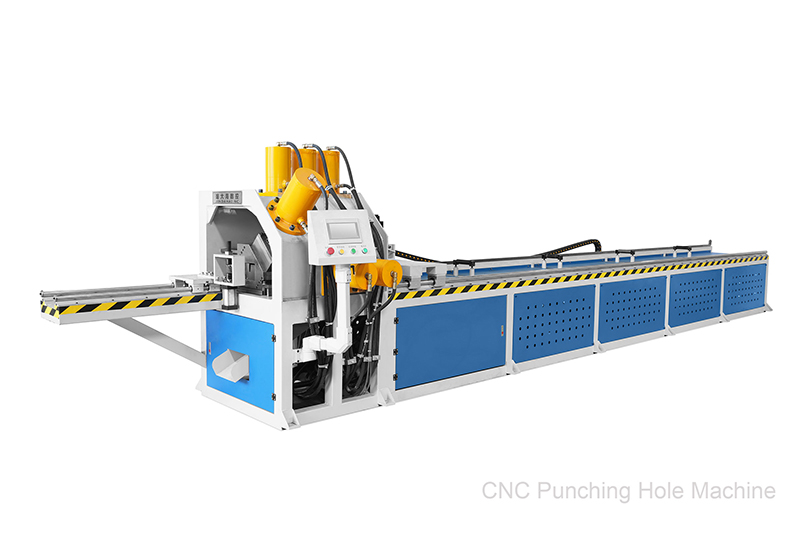
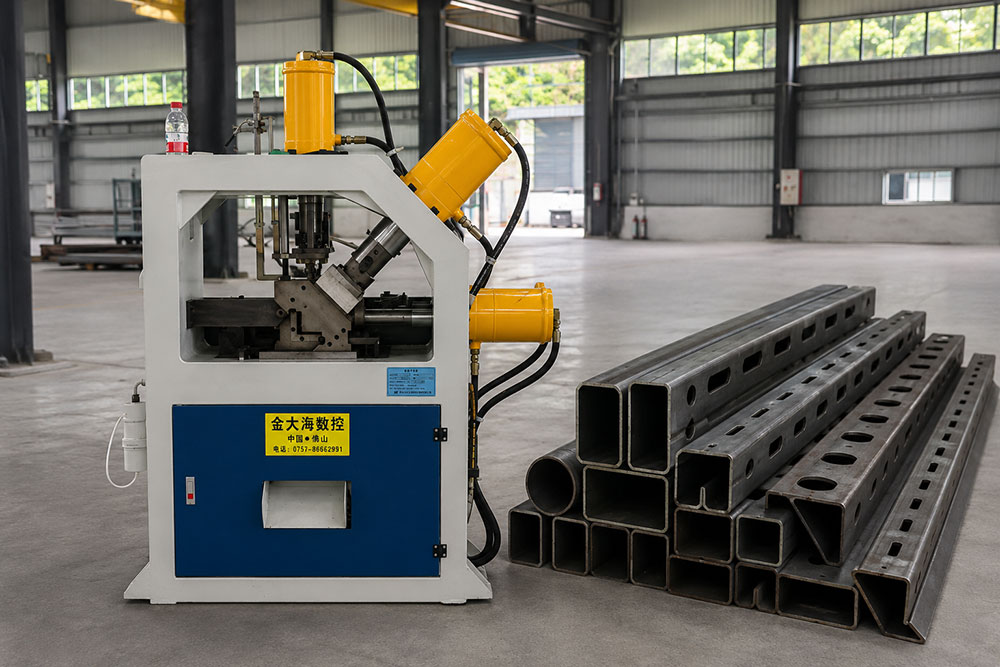
Modern fabrication is not only about making metal parts. It is about making those parts accurately, repeatedly, and economically under real production pressure. Customers want shorter lead times, tighter tolerances, and more dependable quality. Factories want better labor efficiency, lower scrap rates, and smoother workflows from raw material to finished product. In that environment, machines that improve repeatability have become more valuable than ever. That is one reason the CNC punching machine continues to play such an important role in industrial manufacturing.
On paper, punching sounds simple. A machine makes a hole, the workpiece moves, and the job continues. But inside a real factory, punching has much greater influence than its simple appearance suggests. Hole location affects assembly. Hole spacing affects standardization. Hole quality affects whether the part can move directly into welding, fastening, coating, or installation without extra work. When the punching stage is unstable, the entire production system becomes less predictable. When the punching stage is controlled well, later processes become faster and easier to manage.
This is why more manufacturers have moved beyond treating punching as a minor workshop task. They now see it as a key step in production planning and process control. Manual marking and drilling may still have a place in small-volume work, but repeated hole-making becomes expensive when it depends too heavily on labor, concentration, and repeated measurement. CNC punching changes that by storing the process in a program rather than rebuilding it hole by hole through human judgment.
For factories producing structural parts, racks, supports, frames, enclosures, solar components, and profile-based assemblies, this matters a great deal. A more controlled punching process reduces unnecessary variation. It also helps transform repeated manual effort into repeatable output. That is the real reason CNC punching still matters. It remains practical, relevant, and closely connected to the everyday needs of modern metal fabrication.
This article explains the subject from a practical point of view. It looks at how CNC punching machines are used, how they work, how they should be operated, and what real advantages they bring to factory production. It is written as a broad educational guide, especially for readers who want to understand not only what the machine is, but why it continues to be useful in a market full of changing technologies.
Why Punching Affects More Than One Process
In many workshops, punching is easy to overlook because it does not look as dramatic as cutting a long section or welding a large frame. Yet the effect of punching can be wider than those more visible operations. A part may look acceptable after punching, but if the holes are not positioned correctly, the problem will appear later. The part may not align during assembly. Bolts may need forcing. Extra drilling may be required. A part that should move quickly through production may become a delay point.
This is one of the hidden reasons punching has such an important role in fabrication. It prepares the workpiece for every later step. If punching is inaccurate, downstream departments pay the price. If punching is stable, the benefits are felt throughout the workflow. A good punching process helps the next department move faster. A poor one creates frustration, rework, and uncertainty.
Manual methods become especially weak in repeated work. When the same part family is produced again and again, measuring each location manually takes time and increases the chance of human variation. Different operators may handle spacing slightly differently. Fatigue may reduce attention. Small inconsistencies accumulate and begin to affect production rhythm. In low volume, that may be manageable. In medium- or large-volume production, it becomes costly.
CNC punching matters because it reduces that variability. Once the hole pattern is entered and verified, the machine does not need to rediscover the same layout for every part. It repeats the stored logic. This improves consistency not only across one batch, but across future batches as well. Factories that care about stable quality, predictable output, and efficient labor use usually recognize that this kind of repeatability is not a luxury. It is part of what keeps production commercially viable.
Another reason punching matters is that it is often one of the first places where a factory begins standardizing its workflow. A punching process that is consistent and measurable creates a stronger foundation for everything else. This is especially true in businesses where profile-based parts are central to the product line.
What a CNC Punching Machine Is Designed to Do
A CNC punching machine is designed to create holes, slots, and other punched shapes in metal materials according to programmed data. The letters CNC stand for Computer Numerical Control, which means the machine uses stored instructions to guide the movement of the workpiece and the punching sequence. This separates it from purely manual punching or repeated drilling, where hole position is recreated physically by the operator each time.
In a practical sense, the machine is built to control repetition. It allows a factory to define hole patterns digitally and then reproduce them across many parts. That makes it valuable in production environments where accuracy and consistency matter just as much as raw speed. A factory does not gain much from making a single perfect sample if the rest of the batch becomes inconsistent. CNC punching is useful because it helps maintain the same standard over time.
Different CNC punching machines are built for different workpiece forms. Some are better suited for flat stock. Others are built specifically for profile materials such as angle steel, channel steel, flat bar, square tube, rectangular tube, or round pipe. Some focus only on punching. Others may include cutting or related operations in the same workflow. The structure depends on production needs, but the central purpose stays the same: to improve how repeated hole-making is performed.
This also changes the role of the operator. Instead of spending most of the time measuring and aligning every individual hole, the operator focuses more on preparation, setup, monitoring, and quality control. That is one reason CNC punching often improves not only output, but also the way labor is used in a workshop. It shifts value away from low-level repetition and toward better process supervision.
Because of this, CNC punching machines should not be understood only as tools for making holes. They are process-control tools. Their value lies in how they help turn a repeated manual activity into a more structured production method.
Where CNC Punching Machines Are Used
The market uses of CNC punching machines are broad because repeated punched features appear in many kinds of industrial products. One of the most common areas is structural and construction-related fabrication. Support members, brackets, connectors, installation parts, and similar products often need accurately placed holes so they can be fastened or assembled without modification. This is why manufacturers producing structural support systems often find CNC punching highly practical.
Another major area is storage and logistics equipment. Rack uprights, shelf supports, beams, and related components usually require evenly spaced holes across long production runs. In these products, standardization is essential. A small difference in hole spacing can affect compatibility across multiple components. That is why CNC punching is particularly useful in rack and shelving components, where consistency matters just as much as speed.
The solar industry has also created strong demand for punched profile processing. Solar brackets, rails, and support members often contain repeated punched positions for connectors, bolts, and fastening systems. Because these products are commonly produced in batches and use recurring patterns, they are well suited to CNC punching. This makes solar support rails an excellent real-world application.
Tube and profile processing is another large category. Square tube, round pipe, rectangular tube, channel steel, and angle steel are used in machine frames, fences, industrial supports, custom equipment, and other fabricated assemblies. When readers encounter references to square tube punching, linking to a related case page is usually more helpful than linking only to a general machine page, because it shows the process in a more direct application context.
There are also many secondary markets. CNC punching can be used for agricultural supports, enclosure structures, transport components, equipment accessories, commercial display frames, and custom fabricated parts. The end markets vary, but the production requirement remains similar: repeated holes must be made accurately, efficiently, and in a way that supports downstream production instead of creating extra correction work.
What Materials and Shapes Can Be Processed
A CNC punching machine is not universal by default. Its actual processing range depends on machine structure, force, tooling, clamping method, and workpiece handling. In general, however, these machines are commonly used with mild steel, stainless steel, aluminum, galvanized steel, and certain alloy materials. The thickness range depends on the machine model and the type of profile being processed.
Profile form is equally important. Common shapes include angle steel, channel steel, flat bar, square tube, round pipe, and rectangular tube. Some machines are designed mainly for lighter profile work, while others are intended for more structural applications. This is why buyers should think first about their daily products rather than starting only from general machine descriptions.
Material behavior also affects results. Long profiles may need stronger support to prevent sagging during feeding. Thin-walled sections may require careful punch-and-die matching to keep hole edges clean. Heavier sections may need stronger clamping and a more rigid frame. In actual production, a machine does not succeed just because it has enough force. It succeeds because the full process is matched correctly to the material.
Tooling has a major effect on outcome as well. A machine with high force can still deliver poor results if the tooling is incorrect or worn. Burrs, rough edges, inconsistent hole size, and excessive wear often come from tooling mismatch. This is one reason experienced factories do not evaluate punching quality based only on the machine body. They look at the whole system: material, profile form, support, tooling, clamping, and program accuracy.
This is also why setup knowledge remains important even in automated processes. CNC punching reduces repeated manual effort, but it does not eliminate the need for technical judgment. Choosing the right machine and tooling combination remains one of the most important factors in achieving stable long-term results.
How the CNC Punching Process Works
The CNC punching process can be understood clearly when broken into its main stages. The first stage is job preparation. The operator studies the drawing or order requirement and identifies the material type, profile form, hole quantity, spacing, hole diameter, and punching sequence. These details are then entered into the machine control system.
The second stage is material loading. The workpiece is placed on the machine either manually or with supporting equipment. For long profiles, additional support systems may be needed to keep the workpiece stable and level during feeding. Without stable support, even a correctly programmed machine may produce inaccurate results.
The third stage is feeding and positioning. The control system moves the workpiece to the correct punching point. Many CNC punching machines use servo-controlled feeding because it provides better repeatability over multiple cycles. Once the material reaches the correct position, the punch moves through the workpiece into the die and forms the required hole.
The fourth stage is repetition. The machine advances to the next programmed location and continues punching until the full pattern is completed. This is where CNC punching shows its strongest advantage. The operator does not need to rebuild the pattern manually. The machine repeats the stored logic across the batch, which saves time and reduces variation.
The fifth stage is transfer to the next production step. Depending on the part, the punched workpiece may go to cutting, welding, bending, coating, fastening, or assembly. This is why the machine should not be judged only by its punching speed. A properly punched part saves time for every later department. In real production, that downstream value is often just as important as the speed at the punching station itself.
Another important point is that the process should be viewed as a whole rather than as isolated movements. Programming, support, feeding, tooling, and punching all work together. If one part of the system is weak, final quality suffers. That is why factories that get the most from CNC punching usually pay close attention to the complete workflow rather than focusing on only one specification.
How to Use a CNC Punching Machine Correctly
Using a CNC punching machine correctly starts long before the punch touches the material. Good output depends on preparation, tooling selection, workpiece stability, and process discipline. Because CNC equipment is fast and repeatable, mistakes in setup can also be repeated very quickly if they are not controlled.
The first step is careful drawing review. Operators should check hole positions, spacing, part orientation, quantity, and material dimensions before the run begins. Even a small input mistake can affect the full batch, so setup needs to be treated seriously.
The second step is tooling selection and inspection. The punch and die must match the material and the required hole shape. If tooling is mismatched, the results may include burrs, inaccurate edges, or unstable dimensions. Tool wear must also be monitored. Even the correct tooling gradually becomes less effective over time, and worn tools can reduce quality without obvious machine failure.
The third step is stable clamping and support. If the workpiece shifts during feeding or punching, hole location will no longer match the program. Long profiles especially require proper support to prevent sagging or twisting. Many accuracy problems begin not in software, but in material handling.
The fourth step is first-piece verification. Before full batch production starts, the operator should check one sample part carefully. Hole spacing, edge quality, location, and overall part condition should all be confirmed. This step is one of the most effective ways to prevent batch scrap and protect quality control.
The fifth step is attention during the run. CNC punching reduces repeated handwork, but the operator still needs to observe sound, vibration, tooling marks, and feed behavior. Small signs of trouble often appear before major quality loss begins. Good operators do not simply start the cycle and walk away. They stay aware of process condition.
Finally, maintenance must be part of routine production practice. Cleaning, lubrication, clamp inspection, and tooling care all contribute to stable long-term performance. A well-maintained machine is easier to trust, easier to plan around, and more likely to deliver consistent output over time.
What Benefits CNC Punching Brings to Industry
The benefits of CNC punching reach beyond speed. Faster throughput is one clear advantage, especially in repeated work where manual measuring and drilling take too much time. Once the pattern is programmed and verified, the machine can process batch parts much more efficiently.
Another important benefit is consistency. Because the machine follows stored coordinates, the same pattern can be reproduced more reliably. This helps later steps such as fastening, welding, and assembly because parts arrive in a more standardized condition.
Labor efficiency is also improved. Instead of using worker time for repeated measuring and alignment, CNC punching shifts labor toward setup, supervision, and inspection. This does not make workers unimportant. It changes where their value is applied. In many workshops, that shift is one of the most meaningful long-term advantages.
Material savings are another strong benefit. Incorrect holes often lead to scrap or rework. A stable punching process reduces those losses and improves first-pass yield. Over time, even modest savings in waste can create significant production benefits.
Planning becomes more reliable as well. A punching process that is more repeatable gives management a better idea of cycle time, batch stability, and downstream timing. That supports better scheduling and improves confidence across the factory.
Perhaps most importantly, CNC punching supports overall workflow stability. A correctly punched part is easier for the next department to handle. In that way, the machine improves not just its own station, but the efficiency of the whole production line.
How CNC Punching Supports Modern Production Thinking
Modern production is increasingly focused on repeatability, visibility, and control. Factories want to understand how long a job should take, how stable the output will be, and how easily the same result can be reproduced in the future. CNC punching supports this kind of thinking because it turns repeated hole-making into a programmed operation rather than a repeated manual task.
This helps factories become more systematic. The process becomes easier to measure. Cycle time becomes easier to estimate. Quality becomes easier to standardize. Even when the workshop handles different orders, the punching logic can still be managed more consistently than under a purely manual approach.
At the same time, CNC punching still supports flexibility. Factories do not always produce the same part every day. Many produce different but related product families. Because the hole logic is stored digitally, the process can be adapted more easily than a fully manual workflow. That combination of repeatability and flexibility is one reason CNC punching remains so relevant.
For a modern fabrication business, this matters because efficiency is no longer measured only by how fast one person can work. It is measured by how well the whole system can deliver consistent output across changing orders. CNC punching supports that broader goal very effectively.
How to Choose the Right Machine
Choosing the right machine begins with understanding the real products being made. A factory focused on angle steel supports has different needs from one focused on square tube assemblies or lighter profile work. Material shape, wall thickness, hole pattern complexity, and batch size all matter.
Production style matters too. A workshop handling repeated batches may prioritize long-run stability and feed consistency. A workshop doing more customized jobs may prioritize setup flexibility and easier program adjustment. The best machine is not simply the largest one. It is the one that fits daily production reality.
Support and after-sales service also matter. Tooling supply, spare parts, training, and service response all influence long-term machine value. A machine should be judged by how reliably it supports real work over time, not only by what is written in a specification sheet.
This same logic also applies to SEO content. Broad machine keywords should generally lead to the main product page, while application-specific phrases should lead to relevant case pages. That makes internal linking more useful and keeps the content structure clearer for both readers and search engines.
Common Mistakes Factories Should Avoid
A common mistake is assuming punching is too simple to deserve close process control. In reality, punching errors often appear later, where they become more expensive and more difficult to correct.
Another mistake is skipping first-piece inspection. Even a capable machine can produce incorrect output if the program or setup is wrong. One careful sample check remains one of the most valuable habits in production.
A third mistake is ignoring tooling wear. Worn punches and dies gradually reduce hole quality and can cause burrs, rough edges, or inconsistent size even when the machine frame remains stable.
A fourth mistake is choosing a machine based only on general claims rather than actual workpiece needs. A poor match between the machine and the real product mix often causes disappointment in production.
Finally, weak maintenance creates avoidable instability. Cleaning, lubrication, inspection, and tooling care all help protect output quality over time.
Final Thoughts
CNC punching still matters because it solves practical factory problems. It improves repeatability, reduces unnecessary manual repetition, supports more stable quality, and helps downstream processes run more smoothly. In fabrication environments where profile-based parts and repeated holes are common, these advantages have direct economic value.
For manufacturers that want stronger process control and more dependable production, CNC punching is more than a machine choice. It is a way to improve how work is done. By turning repeated labor into repeatable process logic, it helps the factory become more efficient and more organized.
That is why CNC punching remains relevant, practical, and valuable in modern metal fabrication.